

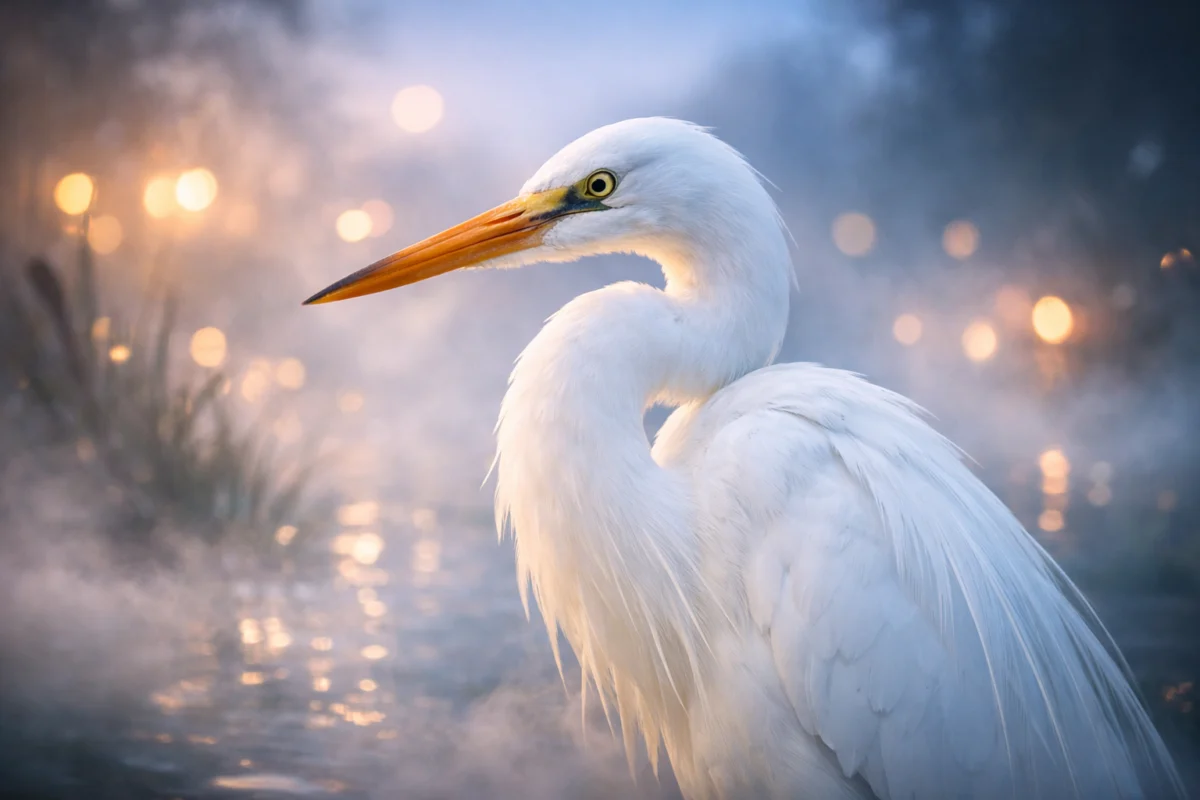
A heron in a dream often points to patience, careful timing, emotional distance, and quiet observation. Because a heron stands still near water and waits before moving, it can symbolize the part of you that is watching a situation before acting.
This symbol is not a prophecy or a fixed sign. A heron dream may show how you are handling choices, relationships, work pressure, or private feelings, depending on what the bird is doing and how you feel in the dream.
The main boundary is simple: the heron usually means measured awareness, not guaranteed success or danger. Its meaning changes with condition, location, color, number, movement, and your interaction with it.
Heron Dream Examples
- You see a calm white heron standing in clear shallow water while the sun is rising, and you feel peaceful.
- A wounded heron struggles beside a muddy pond, and you feel worried but unsure whether to help.
- A gray heron watches you silently from a rooftop, and you cannot tell if it is warning you or simply observing.
- You and a friend walk past a heron that flies away only when your friend speaks loudly.
- A heron stands alone in a city fountain, looking out of place among traffic and people.
- You try to catch a heron, but it steps back, spreads its wings, and escapes before you can touch it.
Heron Dream Meaning: Good or Bad?
A heron dream is often positive when the bird looks healthy, calm, balanced, or graceful. Clear water, open space, and gentle movement may suggest that you are reading a situation well and waiting for the right moment instead of rushing.
The dream can feel negative when the heron is injured, trapped, aggressive, or standing in polluted water. In that case, it may reflect hesitation, emotional strain, poor boundaries, or a situation where patience has turned into avoidance.
Social context matters too. If the heron reacts to another person, follows you, avoids you, or appears in a shared place, the dream may be about how much space, silence, or careful timing you need around others. Overall, a heron dream is usually neither good nor bad by itself; it is a symbol of watchfulness whose meaning depends on the dream context.
Positive Interpretation
If you dream of a calm white heron in clear shallow water, the dream may point to clarity after a period of uncertainty. The clear water suggests visible feelings or honest conditions, while the still heron suggests you are not being passive, but choosing your timing carefully.
If the heron stands at sunrise, the image can strengthen the idea of a fresh start. Because sunrise often marks a new phase, the heron may show that a new opportunity is best approached with patience rather than force. The effect is a sense of quiet readiness.
If a heron watches from a distance without fear, the dream may reflect healthy detachment. You may be learning to observe a problem without becoming overwhelmed by it. This can be useful when you need to make a fair decision, respond to conflict, or avoid reacting too quickly.
If a heron flies away smoothly after being disturbed, the dream can show freedom through boundaries. The bird does not fight or panic; it simply leaves. This may mirror your own need to step away from noise, pressure, or demands before they drain your focus. Very polite bird, very firm boundaries.
Negative Interpretation
If the heron is wounded beside muddy water, the dream may suggest that your patience is being tested by unclear emotions or messy circumstances. The injury does not prove harm in waking life, but it can symbolize a part of you that feels limited, tired, or unable to act cleanly.
If the heron seems trapped in a city fountain, the dream may point to feeling out of place. A heron belongs naturally near open water, so seeing it in a built, crowded, or artificial setting can reflect a mismatch between your needs and your environment.
If you try to catch the heron and it escapes, the dream may show tension between control and respect. You may want an answer, a commitment, or a result too quickly. The escaping heron can suggest that pressure is making something more distant, although this meaning is weaker if the dream felt playful or harmless.
If a gray heron silently watches you from above, the dream may feel uneasy because observation can turn into self-consciousness. It may symbolize your own inner critic, a fear of being judged, or a situation where you feel monitored. Still, without other threatening details, it should not be read as a definite warning.
Different Cultures, Different Meanings
Modern nature symbolism: In many modern dream readings, the heron is linked with patience, balance, solitude, and careful action because of the bird’s real behavior near water. This is a symbolic association, not a universal rule.
Art and literature context: Long-legged water birds can appear in art or writing as images of elegance, stillness, or distance. If you recently saw a heron in a book, photo, video, park, or painting, that personal exposure may matter more than any traditional meaning.
Spiritual or personal belief contexts: Some people may associate herons with intuition, liminal places, or messages because the bird stands between land, air, and water. Such meanings should be handled cautiously and personally, especially if they come from your own beliefs rather than a shared tradition.
Ecological context: If you care about wildlife, wetlands, or environmental issues, a heron dream may connect to your feelings about nature, fragility, or human impact. In that case, the setting of the dream may be more important than the bird alone.
Psychological Perspectives
From a symbolic or psychodynamic view, a heron may represent the observing self: the part of you that waits, studies, and keeps emotional distance before acting. Jungian-style interpretation might see the bird near water as a meeting point between conscious thought and feeling, but the exact meaning still depends on your associations.
From a cognitive or emotional-processing view, the dream may be your mind organizing recent experiences that require patience, restraint, or close attention. A heron can become a useful image for decision-making because it naturally embodies watchfulness, stillness, and sudden movement after a long pause.
From the continuity hypothesis, the dream may continue waking concerns about timing, boundaries, solitude, or social pressure. From a threat-simulation angle, a fleeing, trapped, or wounded heron may help your mind rehearse risk, caution, or escape without proving that any danger will happen.
Heron Symbol Variations & Context Cues
- Condition: A healthy heron may suggest balance and readiness, while a sick, injured, wet, or trapped heron may point to fatigue, blocked movement, or unclear limits.
- Color or material: A white heron may highlight clarity or simplicity, a gray heron may suggest uncertainty or neutrality, and a statue or toy heron may point to an idea of patience rather than a living feeling.
- Number or scale: One heron often emphasizes solitude or focus, many herons may suggest social distance or shared waiting, and a giant heron may make the issue of timing feel larger than usual.
- Movement or behavior: Standing still can mean observation, fishing can mean waiting for the right opportunity, flying can mean release, and attacking can show tension around boundaries.
- Hidden, found, or lost: A hidden heron may point to quiet insight you have not fully noticed, while losing sight of the heron may suggest missed timing or fading attention.
- Location or social setting: A heron in a marsh, river, beach, garden, rooftop, office, or crowded street changes the meaning by showing where patience, distance, or careful action is needed.
Related Symbols & Common Combinations
- Water: Water with a heron often adds emotional tone, showing whether feelings are clear, deep, muddy, calm, or difficult to read.
- Bird: A general bird symbol can add themes of freedom, perspective, messages, or movement between different states of mind.
- Fish: A heron catching or missing fish may point to opportunity, timing, appetite, focus, or the results of waiting.
- Marsh: A marsh, wetland, or reed bed can suggest an in-between place where you are navigating uncertainty slowly and carefully.
What You Should Do If You Dream About Heron
First, note the heron’s condition. Was it calm, alert, wounded, trapped, or flying? A healthy bird may invite you to trust steady observation, while a distressed bird may ask where your patience is becoming strain or where your boundaries feel weak.
Next, record color, texture, or material. A white, gray, blue-toned, black, golden, wooden, glass, or metal heron will not mean the same thing for everyone. Ask what that color or material made you feel in the dream, because your response is often the strongest clue.
Then consider number and scale. One small heron may point to a private matter that needs quiet attention. A flock may connect the symbol to group behavior, social distance, or shared waiting. A huge heron may show that a decision or emotion feels bigger than you expected.
Look at your interaction with the bird. Watching a heron, feeding it, chasing it, helping it, being followed by it, or seeing it fly away all create different meanings. Your role in the dream shows whether you are observing, controlling, caring, avoiding, or learning to let something move on.
Finally, connect the location and social context to waking life. A heron at a river may point to emotional flow, while one in an office may suggest workplace timing or professional distance. If another person appears, ask how their behavior changes the heron’s movement or your feeling.
Heron Vs Similar Dreams
| Aspect | Heron | Crane | Stork | Swan |
|---|---|---|---|---|
| Occasion/Age or Context | Often appears in dreams about waiting, observing, boundaries, or decisions near emotional uncertainty. | Often appears in dreams about grace, discipline, balance, or formal movement. | Often appears in dreams about arrival, care, responsibility, or major life changes, depending on context. | Often appears in dreams about beauty, self-image, emotional bonds, or calm surface appearances. |
| Core Theme | Patient timing, quiet focus, and measured action. | Poise, endurance, and structured elegance. | Transition, delivery, protection, or the arrival of something new. | Grace, sensitivity, reflection, and emotional presentation. |
| Typical Emotions | Calm, curious, cautious, lonely, watched, or thoughtful. | Respectful, focused, peaceful, or impressed. | Hopeful, responsible, surprised, or protective. | Peaceful, romantic only if the dream supports it, proud, vulnerable, or distant. |
| Common Symbols | Water, reeds, fish, marshes, long legs, stillness, sudden flight. | Dance, open fields, tall posture, pairs, wings, balance. | Nests, rooftops, bundles, babies only when present, travel, return. | Lakes, mirrors, white feathers, pairs, reflections, smooth water. |
See Also
More in this category: Animals dreams.
Sources & Further Reading
- NINDS Brain Basics: Understanding Sleep Sleep science
- APA Dictionary of Psychology: Dream Analysis Psychology reference
- Dreaming and the Brain: From Phenomenology to Neurophysiology Research
- Sleep and Dreaming Are for Important Matters Research
- Sleep Foundation: Dreams Editorial background
- Sleep Health Foundation: Dreaming Sleep science