

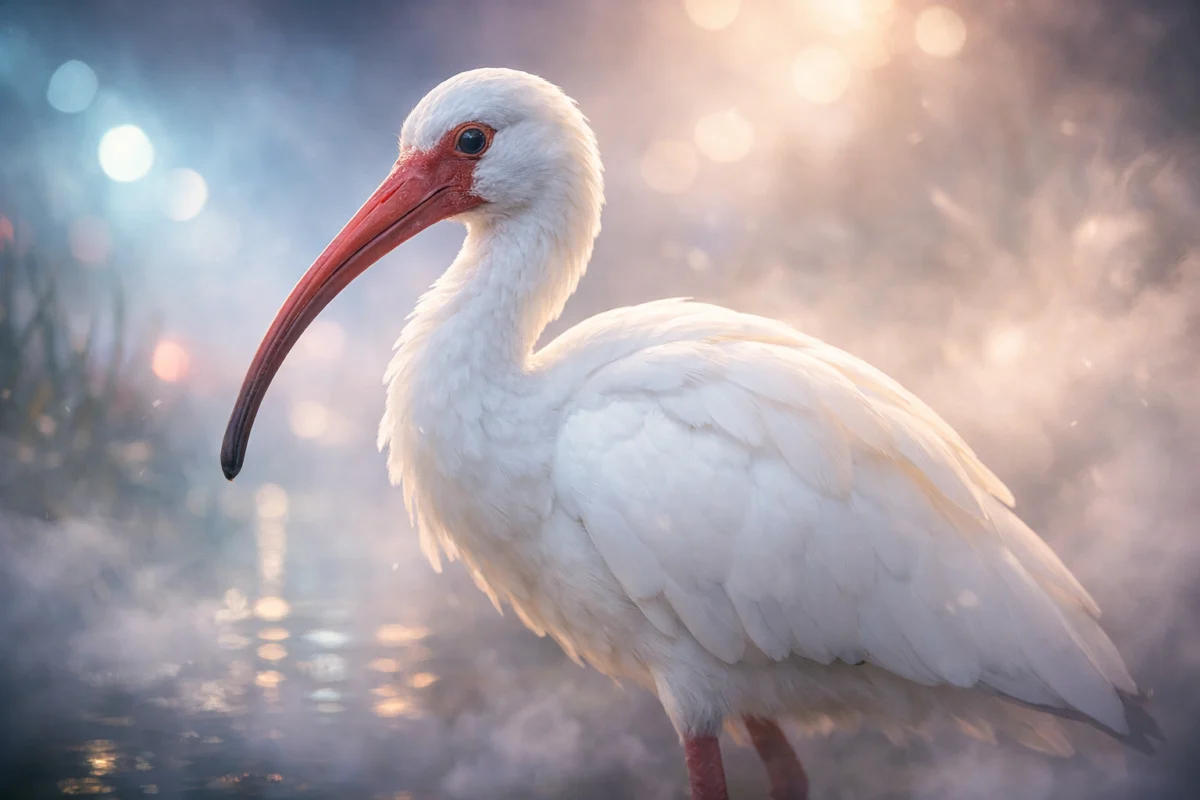
An ibis in a dream often points to careful awareness, searching, timing, and the way you move through uncertain emotional or social ground. Because the ibis is a wading bird, it can symbolize looking for meaning in shallow water, mud, wetlands, or places where things are partly hidden.
This symbol is not a fixed prophecy. It does not automatically mean luck, danger, wisdom, or a message from outside yourself. Its meaning depends on what the ibis is doing, where it appears, how it looks, and how you feel around it.
In many dreams, the ibis asks you to notice what is subtle rather than loud. You may be sorting through facts, moods, choices, or relationships with more patience than usual. The bird is not rushing, and your dream may be inviting you not to rush either.
Ibis Dream Examples
- You see a healthy white ibis walking calmly through clear shallow water while the sun is rising.
- An injured ibis stands in dirty water and cannot fly away, while you feel worried but unsure how to help.
- A group of ibises gathers silently on a city street after heavy rain, and nobody else seems to notice them.
- An ibis follows you beside a river, keeping a steady distance as if it is watching your choices.
- You find an ibis inside your home, standing near a window, and you feel both surprised and curious.
- You try to feed an ibis, but it keeps moving away and pecking at the ground instead of taking food from your hand.
Ibis Dream Meaning: Good or Bad?
An ibis dream can feel positive when the bird looks healthy, balanced, free, or peaceful. Clear water, open skies, gentle movement, and a calm feeling often suggest that you are noticing useful details and making space for clearer judgment.
The dream can feel more difficult when the ibis is trapped, injured, aggressive, lost, or surrounded by pollution, darkness, or confusion. In that case, the symbol may point to blocked insight, emotional heaviness, poor timing, or a situation where you are trying to understand something without enough information.
Relationships and social context matter too. An ibis alone may reflect private reflection, while a group of ibises may point to social signals, group pressure, or shared concerns. If someone else interacts with the ibis, ask what that person represents in your current life. Overall, an ibis dream is neither strictly good nor bad; it usually reflects how you are searching, observing, and adapting.
Positive Interpretation
If you dream of a healthy white ibis walking through clear water, the image may suggest clean perception. The bird can move through water without sinking, so the dream may show that you are handling emotion, uncertainty, or a delicate decision with balance. The effect is a sense of quiet confidence rather than dramatic certainty.
If an ibis appears at sunrise, the timing can add a theme of renewal. You may be at the early stage of understanding something. Because sunrise marks a beginning, the ibis may represent your ability to notice small signs before a bigger change becomes obvious.
If an ibis follows you at a steady distance, the dream may show that your awareness is close but not intrusive. You may already sense what needs attention, even if you have not fully named it. The effect can be useful self-monitoring, where you observe your choices without attacking yourself for them.
If you find an ibis near a window in your home, the symbol may connect inner life with outer perspective. A window lets you look out while still feeling protected. This can suggest that you are ready to view a personal issue from a wider angle, perhaps with more curiosity and less defensiveness.
Negative Interpretation
An injured ibis in dirty water may point to insight that feels blocked or weakened. The water condition matters because murky water often suggests unclear emotion, poor information, or confusion. Still, the dream does not prove that something is wrong; it may simply show that your mind is processing strain through a vulnerable image.
If the ibis cannot fly, the dream may reflect a feeling of limited options. Flight often relates to freedom, distance, and perspective. When the bird is grounded against its will, you may feel stuck in a decision or unable to rise above a situation. This meaning is stronger if you felt helpless in the dream.
A group of silent ibises in a city street can feel strange because the bird is out of its expected wetland setting. This may suggest that natural instincts or quiet observations are appearing in a public, practical, or work-related area of life. If the mood was tense, the dream may point to social discomfort or signals that others are ignoring.
If you try to feed an ibis and it keeps moving away, the dream may show a mismatch between your help and what is actually needed. You may be offering advice, care, or effort in a way that does not fit the situation. However, if the bird was simply foraging, the evidence for rejection is weak; it may only show independence.
Different Cultures, Different Meanings
Ancient Egyptian context: The ibis is strongly associated with ancient Egypt, especially with Thoth, a deity linked with writing, knowledge, and measurement. In a modern dream, this can support themes of learning, record keeping, thought, or careful judgment, but only if that association is meaningful to you or appears clearly in the dream.
Modern nature symbolism: In many everyday contexts, an ibis is simply a wetland or shore bird. This makes it a useful symbol for patience, searching, adaptation, and feeding from what the environment provides. Personal experience with the bird matters more than any broad cultural claim.
Urban wildlife context: In places where ibises are seen in cities, parks, or near bins, the dream may carry a practical survival theme. It may suggest making use of imperfect conditions, navigating public spaces, or adapting to a changed environment. Yes, even a dignified bird sometimes has to deal with leftovers.
Psychological Perspectives
From a symbolic or psychodynamic view, the ibis may represent the observing part of you that searches below the surface. A Jungian approach might see the bird as an image of instinctive guidance or quiet intelligence, especially if it appears near water. A Freudian reading would be more cautious and would look at your personal associations, recent experiences, and emotional reactions rather than assigning one universal meaning.
From a cognitive or emotional-processing view, an ibis dream may combine recent visual memories, emotional concerns, and problem-solving. The bird’s slow searching behavior can mirror the way your mind reviews details while you sleep. If you have recently seen birds, wetlands, documentaries, city wildlife, or images of ancient Egypt, the ibis may be part of normal memory blending.
From the continuity hypothesis, dreams often continue themes from waking life. An ibis may appear when you are navigating uncertainty, reading social cues, or looking for a careful way forward. From a threat-simulation angle, an injured, trapped, or watched ibis may help your mind rehearse concern, caution, or protective behavior without predicting a real event.
Ibis Symbol Variations & Context Cues
- Condition: A healthy ibis often supports themes of balance and good observation, while a sick, injured, dead, or trapped ibis may show blocked awareness, fatigue, or concern.
- Color or material: A white ibis may suggest clarity or simplicity, a dark ibis may point to mystery or hidden feelings, and a statue or carved ibis may suggest fixed ideas, memory, or formal knowledge.
- Number or scale: One ibis can reflect private reflection, many ibises can suggest group signals or shared patterns, and a giant ibis may show that a subtle issue feels much larger than expected.
- Movement or behavior: Wading, pecking, flying, nesting, calling, or watching you changes the meaning. Searching behavior often points to inquiry, while flight may suggest perspective or release.
- Hidden, found, or lost: Finding an ibis may show a new insight. Losing sight of one may suggest missed cues. A hidden ibis may reflect a truth or feeling you sense but cannot fully access.
- Location or social setting: An ibis in water suggests emotional searching, in your home suggests personal reflection, in a workplace suggests practical judgment, and in a crowd suggests social awareness.
Related Symbols & Common Combinations
- Bird: Birds often connect with perspective, thought, freedom, and messages from your own awareness, so an ibis adds patience and careful searching to that wider bird symbolism.
- Water: Water often reflects emotion, memory, and the unconscious. An ibis in water may show you examining feelings without being fully overwhelmed by them.
- Heron: A heron dream is similar because it also involves stillness, patience, and wading, but it may feel more solitary, watchful, or poised than an ibis.
- Egyptian symbols: If the ibis appears with scrolls, pyramids, writing, or temples, the dream may emphasize learning, memory, records, or the wish to understand something with precision.
What You Should Do If You Dream About Ibis
Start with the ibis’s condition. Write down whether it was healthy, injured, trapped, calm, active, or dead. This gives you the emotional tone of the symbol. A strong, graceful ibis may point to useful awareness, while a distressed ibis may show that some part of your attention feels strained.
Next, note the color or material. A living white ibis in clear water is different from a black ibis in a dark room or a golden ibis statue in a museum. Color can show mood, while material can show whether the symbol felt alive, frozen, valuable, distant, or ceremonial.
Then consider number and scale. One ibis may ask you to focus on one quiet issue. A flock may point to repeated signals, group behavior, or a pattern involving more than one person. A very large ibis may show that something you thought was minor now feels important.
Look at your interaction with the bird. Were you watching it, following it, feeding it, rescuing it, avoiding it, or being followed by it? Your role in the dream shows how you are relating to awareness itself. Trying to help the ibis may suggest care, while chasing it may suggest pressure or impatience.
Finally, connect the location to waking life. An ibis in a wetland may relate to emotional exploration. In your house, it may point to private thoughts. At work or school, it may relate to judgment, learning, or social observation. In a city, it may show adaptation in an imperfect environment.
Ibis Vs Similar Dreams
| Aspect | Ibis | Heron | Stork | Crane |
|---|---|---|---|---|
| Occasion/Age or Context | Often appears in dreams about searching, timing, subtle cues, wetlands, cities, or reflective decisions. | Often appears in quiet, solitary, patient, or watchful dream settings. | Often appears in dreams about arrival, transition, care, or life changes, depending on context. | Often appears in dreams about grace, balance, endurance, or formal movement. |
| Core Theme | Careful awareness and adapting while you look beneath the surface. | Stillness, patience, and waiting for the right moment. | Transition, delivery, responsibility, or new developments. | Poise, discipline, longevity, and measured action. |
| Typical Emotions | Curiosity, caution, quiet focus, concern, or mild wonder. | Calm, loneliness, patience, or alertness. | Hope, nervousness, expectation, or responsibility. | Respect, steadiness, elegance, or emotional control. |
| Common Symbols | Shallow water, mud, sunrise, city streets, windows, flocks, and searching behavior. | Reeds, lakes, still water, fish, long legs, and silent watching. | Nests, rooftops, babies, journeys, bundles, and open skies. | Dancing, flight, temples, fields, pairs, and balanced postures. |
More in this category: Animals dreams.
Sources & Further Reading
- NINDS Brain Basics: Understanding Sleep Sleep science
- APA Dictionary of Psychology: Dream Analysis Psychology reference
- Dreaming and the Brain: From Phenomenology to Neurophysiology Research
- Sleep and Dreaming Are for Important Matters Research
- Sleep Foundation: Dreams Editorial background
- Sleep Health Foundation: Dreaming Sleep science