

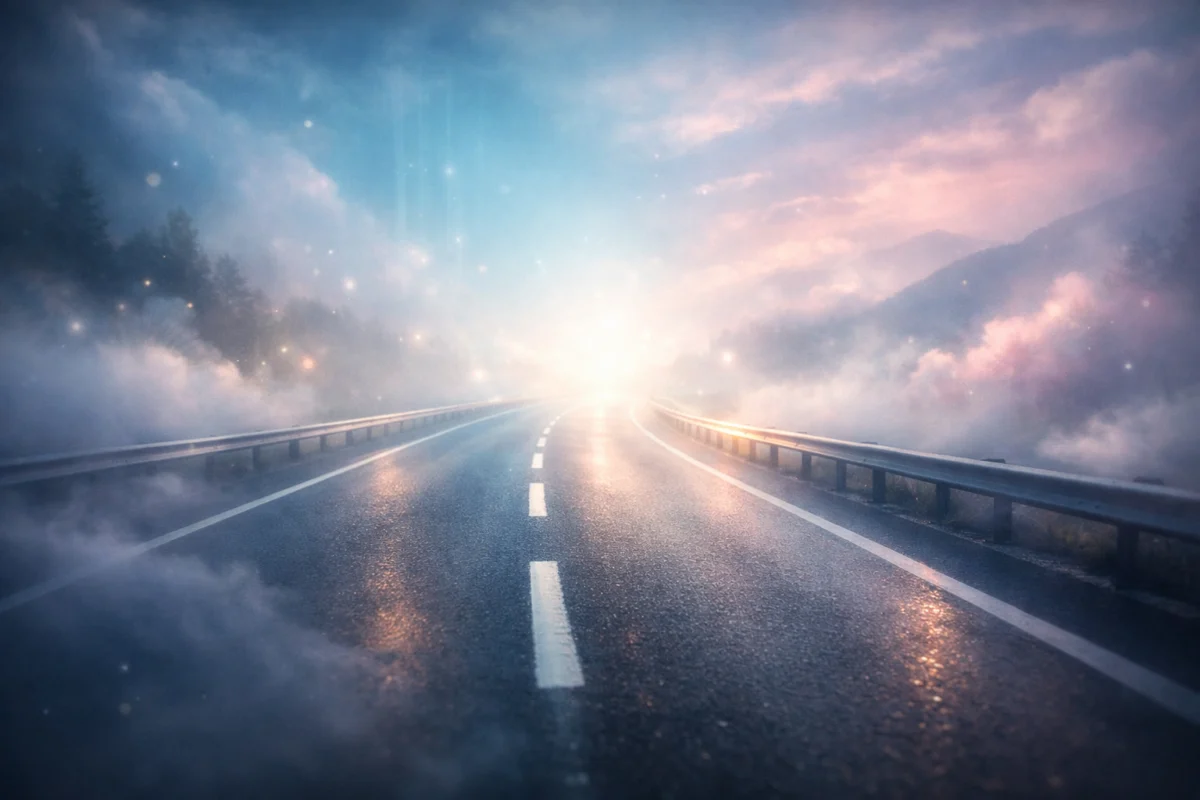
A highway in a dream often points to direction, movement, pace, and the larger route you feel you are taking in life. Unlike a small street or private path, a highway usually suggests a bigger system, a shared route, or a goal that seems to require speed and focus.
- Highway Dream Examples
- Highway Dream Meaning: Good or Bad?
- Different Cultures, Different Meanings
- Psychological Perspectives
- Highway Symbol Variations & Context Cues
- Related Symbols & Common Combinations
- What You Should Do If You Dream About Highway
- Highway Vs Similar Dreams
- See Also
- Sources & Further Reading
- FAQ
This symbol is not a prediction. Dreaming of a highway does not mean a trip, success, danger, or delay must happen. It is better read as a flexible image for how you are moving through choices, responsibilities, pressure, and long-range plans.
The meaning depends on concrete details: whether the highway is clear or blocked, whether you are driving or watching, whether you feel calm or trapped, and whether other people are with you. The dream is the road map, but you still get to check the signs.
Highway Dream Examples
- You drive on a wide, clean highway under a bright sky, moving at a steady speed and feeling confident about where you are going.
- You are stuck in heavy highway traffic, surrounded by impatient drivers, and you feel late, boxed in, or unable to change lanes.
- You stand on an empty highway at night, unsure whether to walk forward, turn back, or wait for a ride.
- You ride with a partner, friend, coworker, or family member on a highway, and the mood between you affects how safe or tense the trip feels.
- You see a highway crossing a desert, forest, city, bridge, or mountain, and the surrounding landscape feels more important than the cars.
- You miss an exit, make a sudden turn, speed too fast, brake hard, or merge into traffic while trying to avoid an accident.
Highway Dream Meaning: Good or Bad?
A highway dream can feel positive when the road is open, bright, smooth, and easy to follow. These details may suggest confidence, momentum, clearer direction, or a sense that your current plans have enough structure to keep moving.
The dream can feel negative when the highway is blocked, damaged, dark, flooded, confusing, or too fast. Your level of agency matters. Driving usually points to active choice, while being a passenger may suggest trust, dependence, shared plans, or feeling carried along by someone else’s pace.
Relationships and social context also matter. A crowded highway may reflect comparison, pressure, competition, or shared routines, while a lonely highway may show independence, isolation, or a private transition. Overall, a highway dream is not simply good or bad; it shows how you feel about your current direction and speed.
Positive Interpretation
If you are driving on a wide, clean highway under a bright sky, the dream may show that your waking life has a clear route and enough energy to support progress. The cause is the open road and stable movement; the effect is a feeling of confidence, planning, and forward motion.
If you are merging smoothly into traffic, the dream can suggest that you are finding your place within a group, workplace, family system, or social routine. Because merging requires timing and awareness, it may reflect growing skill in adjusting to others without losing your own direction.
If the highway crosses a beautiful landscape, such as mountains, coastline, or forest, the dream may point to a meaningful stage of growth rather than only practical goals. The road shows movement, while the setting adds emotional color. This can suggest that the process itself matters, not just the destination.
If you ride with someone and the trip feels calm, cooperative, and safe, the highway may symbolize shared direction. The cause is not simply the person’s presence, but the way you travel together. If the mood is steady, the dream may reflect trust, teamwork, or an easier rhythm in a shared plan.
Negative Interpretation
If you are trapped in highway traffic, the dream may reflect delay, frustration, or pressure caused by systems larger than you. This could relate to work, study, bureaucracy, group expectations, or routines. The limit is important: traffic alone does not prove you are stuck in life; it only suggests you may feel slowed down in one area.
If you miss an exit, the dream can point to anxiety about timing, opportunity, or decisions. The missed exit is a concrete cue for feeling that a choice passed quickly or required faster action than you had available. It may also simply mirror a busy mind trying to organize options.
If the highway is dark, icy, broken, or hard to see, it may suggest uncertainty about the road ahead. Poor visibility often matters more than the highway itself. You may be moving forward, but without enough information, support, or confidence to feel settled.
If another person drives too fast while you sit as a passenger, the dream may show discomfort with someone else’s pace or choices. This does not automatically mean that person is harmful. The stronger evidence is your feeling in the dream: fear, silence, pressure, or an inability to speak up can point to low agency in a shared situation.
Different Cultures, Different Meanings
Modern life and travel context: Highways are strongly tied to cars, commuting, long-distance travel, and public infrastructure. Because of this, the symbol is often more modern and personal than ancient or folkloric. Your own experience with driving, road trips, traffic, and travel usually matters most.
Work and productivity context: In a practical modern reading, a highway can represent career direction, deadlines, routines, or the pressure to keep moving. A fast highway may feel efficient if you are in control, but stressful if the pace feels forced.
Rites of passage and life stages: Roads in general often symbolize journeys or transitions in literature and common speech. A highway adds scale, speed, and public movement. It may appear during changes such as leaving school, starting work, moving, changing roles, or reconsidering long-term goals.
Personal and regional context: If you live in a place where highways shape daily life, the dream may connect directly to commuting stress or freedom of movement. If highways are rare or unfamiliar to you, the image may feel larger, more intimidating, or more symbolic of entering unknown territory.
Psychological Perspectives
From a symbolic or psychodynamic view, a highway can represent the path your ego or conscious identity feels it must take. Freud is not needed for every road dream, but a classic symbolic approach would ask what desire, pressure, or conflict is carried by the journey. Jungian-style interpretation might focus on the highway as part of a larger life journey, especially if the dream includes thresholds, signs, bridges, tunnels, or distant horizons.
From a cognitive or emotional-processing view, the highway may be your mind organizing movement, decisions, and pace. If you have been making plans, commuting, facing deadlines, or comparing options, the dream may combine those waking concerns into a road scene. The emotional tone can show whether your mind is processing confidence, overload, uncertainty, or adjustment.
From the continuity hypothesis, dreams often continue themes from waking life, so a highway may reflect real concerns about direction, work, travel, or responsibility. From a threat-simulation view, associated with Antti Revonsuo’s theory, dangerous highway scenes may allow the mind to rehearse risk, speed, loss of control, or sudden obstacles. This does not mean danger is coming; it may mean the dream is modeling pressure and response.
Highway Symbol Variations & Context Cues
- Condition: A smooth highway may suggest ease and flow, while a cracked, flooded, icy, or blocked highway may point to uncertainty, delay, emotional strain, or practical obstacles.
- Color/material: Black asphalt can feel ordinary and realistic, bright pavement may suggest clarity, red lights or warning signs may highlight caution, and wet reflective roads may show emotional sensitivity or unclear perception.
- Number/scale: Many lanes may suggest many options, pressure, or social comparison. A huge empty highway can feel freeing or lonely, depending on whether you feel safe, lost, or peaceful.
- Movement/behavior: Speeding, braking, merging, exiting, reversing, or changing lanes shows how you handle timing, decisions, boundaries, and adjustment.
- Hidden/found/lost: A hidden exit, lost route, missing sign, or suddenly discovered shortcut may point to overlooked choices, poor information, or a new way through a situation.
- Location/social setting: A highway through a city may connect to public life and work, while one through a desert, forest, bridge, or mountain may emphasize isolation, transition, challenge, or long-term growth.
Related Symbols & Common Combinations
- Car: A car adds focus on control, identity, body energy, and how you personally move through choices.
- Road: A road is a broader path symbol, while a highway usually adds speed, structure, public movement, and long-distance direction.
- Traffic: Traffic highlights delay, comparison, crowd pressure, social timing, or feeling stuck within a larger system.
- Bridge: A bridge on or near a highway can show transition, risk, connection, or the need to cross from one stage to another.
What You Should Do If You Dream About Highway
First, note the condition of the highway. Was it open, damaged, wet, blocked, dark, or under construction? This can help you identify whether the dream is emphasizing ease, delay, repair, caution, or uncertainty in a current life area.
Second, remember the color, light, and material. A bright highway may show clear awareness, while a dark or reflective road may suggest you need more information before moving quickly. Warning signs, lane markings, and lights are especially useful because they often show where your attention is being directed.
Third, consider number and scale. A single lane may point to limited options or focused commitment. Many lanes may show choices, competition, or multitasking. A massive highway may suggest that the issue feels bigger than your private wishes, perhaps tied to work, systems, schedules, or group expectations.
Fourth, look at your interaction with the highway. Were you driving, walking, hitchhiking, waiting, merging, exiting, or watching from above? Your role shows agency. Driving may reflect active choice, while observing may show distance, planning, or hesitation.
Finally, connect the location and social setting to waking life. A highway near your home may relate to daily routine. A highway in a strange land may relate to unfamiliar goals. A highway shared with a specific person may point to how you feel about moving in the same direction, not necessarily about romance or conflict.
Highway Vs Similar Dreams
| Aspect | Highway | Road | Bridge | Traffic |
|---|---|---|---|---|
| Occasion/Age or Context | Often appears during major plans, deadlines, travel, career movement, or fast-paced life changes. | Often appears during general life choices, personal journeys, and everyday direction. | Often appears during transitions, crossings, relationship changes, or movement between stages. | Often appears during delays, crowded routines, social pressure, commuting stress, or blocked progress. |
| Core Theme | Speed, direction, shared systems, long-range movement, and control within a larger route. | Personal path, gradual progress, choice, and the shape of your journey. | Connection, transition, risk, and crossing from one side of a situation to another. | Obstruction, timing, comparison, patience, and frustration with systems or other people. |
| Typical Emotions | Focused, rushed, free, anxious, determined, or uncertain depending on speed and control. | Curious, reflective, hopeful, lost, steady, or cautious. | Nervous, hopeful, exposed, relieved, or tense. | Frustrated, impatient, trapped, resigned, alert, or socially pressured. |
| Common Symbols | Cars, exits, signs, lanes, speed, lights, overpasses, rest stops, and long horizons. | Paths, crossroads, dirt roads, turns, milestones, maps, and walking. | Water below, height, gaps, railings, fog, crossing points, and support structures. | Honking, red lights, stopped cars, lane changes, accidents, detours, and crowded roads. |
See Also
More in this category: Locations dreams.
Sources & Further Reading
- NINDS Brain Basics: Understanding Sleep Sleep science
- APA Dictionary of Psychology: Dream Analysis Psychology reference
- Dreaming and the Brain: From Phenomenology to Neurophysiology Research
- Sleep and Dreaming Are for Important Matters Research
- Sleep Foundation: Dreams Editorial background
- Sleep Health Foundation: Dreaming Sleep science