

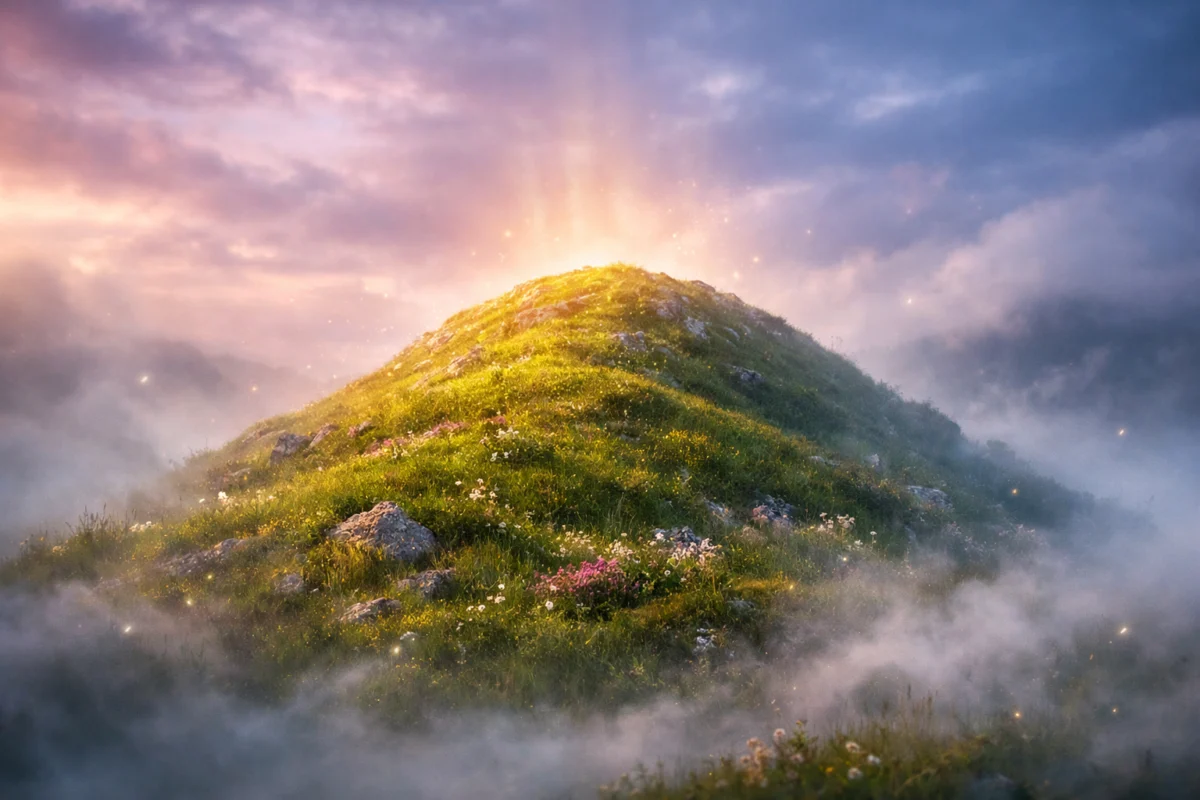
A hill in a dream often symbolizes effort, perspective, progress, delay, or a manageable challenge. Unlike a mountain, a hill usually feels closer to everyday life. It can point to something you are working through step by step.
The meaning depends on what the hill is like and what you do with it. A green hill, a muddy hill, a steep hill, or a hill seen from far away can each suggest a different emotional pattern.
A hill dream is not a prophecy. It is better read as a symbolic scene showing how you relate to pressure, goals, visibility, and the distance between where you are and where you want to be.
Hill Dream Examples
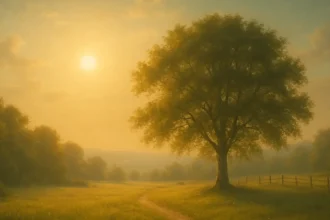
- You walk up a sunny green hill and feel calm when you reach the top.
- You try to climb a steep muddy hill, but your feet keep slipping backward.
- You stand at the bottom of a hill and cannot decide whether to climb it or walk around it.
- You climb a hill with a friend, but they move faster than you and wait at the top.
- You see a lonely hill in the middle of a wide field under a gray sky.
- You run down a hill too quickly and struggle to slow yourself before reaching the road.
Hill Dream Meaning: Good or Bad?
A hill dream can feel positive when the hill is clear, safe, green, or bright. These details may suggest that a challenge is real but not overwhelming. You may be gaining confidence, learning patience, or noticing that steady effort is enough.
Your agency matters. If you choose to climb, rest, turn back, or enjoy the view, the dream may reflect how much control you feel in waking life. If you are pushed, blocked, chased, or unable to move, the hill may show pressure or hesitation.
Relationships and social context also change the meaning. Being helped up a hill can suggest support, while being left behind may show comparison, insecurity, or different pacing with others. Overall, a hill dream is neither good nor bad by itself. It shows how you are experiencing effort, progress, and perspective.
Positive Interpretation
If you walk up a sunny green hill and feel calm, the dream may point to healthy progress. The climb shows effort, and the calm feeling shows that the effort does not feel threatening. Because the hill is green and sunny, the dream may connect challenge with growth, energy, and a clearer outlook.
If you reach the top of a hill, the dream can suggest a useful shift in perspective. From higher ground, you can see more of the landscape. Symbolically, this may mean you are beginning to understand a situation better because you have worked through part of it.
If you climb with a friend and they wait for you, the dream may reflect supportive comparison rather than competition. The friend moving faster can show different timing, while their waiting can suggest that connection remains available even when your pace is not the same.
If you see a hill from a peaceful distance, the dream may show readiness. You may not be climbing yet, but you can clearly identify the task, goal, or emotional rise ahead. Sometimes seeing the hill before climbing it is the mind’s way of planning the route. Very practical of your sleeping brain.
Negative Interpretation
If you try to climb a muddy hill and keep slipping, the dream may reflect frustration with slow progress. The mud matters because it makes the hill harder than it first appears. This can symbolize unclear conditions, poor timing, lack of preparation, or a situation where effort is not producing the expected result.
If the hill is extremely steep, dark, or unstable, it may suggest that a challenge feels bigger than your current energy. This does not prove that the task is impossible. It only suggests that, in the dream, your mind is representing it as demanding, tiring, or hard to approach.
If you stand at the bottom and cannot decide what to do, the dream may reflect hesitation or mixed motivation. The hill can symbolize a choice that requires effort, while your stillness shows uncertainty. If no strong emotion appears in the dream, this interpretation is weaker and may simply point to waiting or observation.
If you run downhill too fast and cannot stop, the hill may symbolize momentum that feels difficult to control. This can relate to rushing, overcommitting, or moving through a situation faster than you can process it. The road at the bottom may add a warning about consequences, but it should still be read symbolically, not as a literal prediction.
Different Cultures, Different Meanings
Modern symbolic context: In many contemporary dream dictionaries, hills are read as symbols of effort, progress, ambition, or perspective. This is a general symbolic pattern, not a fixed rule. Your personal memory of hills matters more than any broad meaning.
Landscape and place memory: If you grew up near hills, hike often, farm, travel through hilly roads, or live in a flat area where hills feel unusual, the dream may draw from real experience. In this case, the hill may symbolize familiarity, distance, physical strain, beauty, or disruption depending on your history.
Spiritual or reflective settings: Some people associate high ground with quiet thought, retreat, or being able to see life from above. This can be relevant if the dream has a peaceful, sacred, or reflective tone. It should not be forced onto dreams that feel practical, stressful, or ordinary.
Psychological Perspectives
From a symbolic or psychodynamic view, a hill may represent the emotional shape of a goal or conflict. Freud focused on hidden wishes and tensions, while Jung often looked at symbols as part of growth and self-understanding. In this kind of reading, climbing a hill may show movement toward awareness, while avoiding it may show resistance or uncertainty.
From a cognitive or emotional-processing view, the hill may organize waking concerns into a simple physical image. Your mind turns effort into terrain. A steep slope, loose stones, a smooth path, or a distant hill can help represent how difficult, clear, or emotionally charged a task feels.
From continuity-hypothesis or threat-simulation perspectives, dreams often reuse waking emotions and concerns. A difficult hill may continue a real-life feeling of pressure. A dangerous descent may simulate loss of control, while reaching the top may rehearse competence. Revonsuo’s threat-simulation theory is useful here when the dream includes risk, chase, slipping, or danger.
Hill Symbol Variations & Context Cues
- Condition: A grassy hill may suggest growth or ease, while a rocky, muddy, icy, or eroded hill may point to difficulty, unstable progress, or poor footing.
- Color or material: Green can suggest renewal, brown can feel practical or grounded, black may add heaviness, white snow may suggest stillness, and stone can point to endurance or resistance.
- Number or scale: One small hill may show a manageable task. Many rolling hills may suggest repeated efforts. A hill that feels almost like a mountain may show that the issue feels larger than expected.
- Movement or behavior: Climbing suggests effort, standing still suggests assessment, sliding suggests loss of control, and resting on the hill may show a need to pause before continuing.
- Hidden, found, or lost: Finding a path over a hill may suggest a new approach. Losing the path can show confusion. A hidden hill appearing suddenly may point to a challenge you had not fully noticed.
- Location or social setting: A hill in a city may connect effort with work or public life. A hill in nature may feel personal or emotional. A crowded hill may bring in comparison, pressure, or shared goals.
Related Symbols & Common Combinations
- Mountain: A mountain usually suggests a larger, more intense challenge than a hill, often with stronger themes of ambition, endurance, or long-term growth.
- Road: A road with a hill can show the direction of your life path, especially if you are driving, walking, blocked, or choosing a route.
- Stairs: Stairs make progress feel structured and step-based, while a hill feels more natural, uneven, and dependent on stamina or terrain.
- Valley: A valley paired with a hill may show emotional lows and recovery, or the contrast between feeling enclosed and gaining perspective.
What You Should Do If You Dream About Hill
First, note the condition of the hill. Was it smooth, muddy, rocky, icy, dry, or covered in grass? The surface can show how easy or difficult progress feels. A rough hill may invite you to ask where waking life feels unstable, while a clear path may suggest you already know the next step.
Second, write down the color or material. A green hill can point toward growth, while a gray or barren hill may show low energy or emotional distance. Stone, sand, snow, or dirt can each change the feeling of the dream. Focus on what the material made you feel, not on a fixed color code.
Third, consider number and scale. One small hill may symbolize one task. A chain of hills may suggest repeated demands or cycles. If the hill kept growing as you approached it, you may be experiencing a goal that feels more difficult the closer you get to it.
Fourth, remember your interaction with the hill. Did you climb, avoid, roll, sit, slide, drive, or look from far away? Your action often shows your relationship to effort. Climbing can show engagement, while standing still may show evaluation. Sliding or falling may suggest that things feel faster or less controlled than you prefer.
Finally, place the hill in its setting. A school hill, workplace hill, childhood hill, public hill, or empty countryside hill can connect the symbol to a specific part of life. If other people were present, ask whether they helped, watched, ignored, competed, or climbed beside you. Social details often explain the emotional tone.
Hill Vs Similar Dreams
| Aspect | Hill | Mountain | Stairs | Valley |
|---|---|---|---|---|
| Occasion/Age or Context | Often appears when you face a manageable challenge, transition, or need for perspective. | Often appears with major goals, long efforts, ambition, or a challenge that feels large. | Often appears when progress feels ordered, step-based, social, or connected to levels. | Often appears during low points, rest periods, emotional depth, or recovery after effort. |
| Core Theme | Gradual effort, practical progress, and seeing more clearly from higher ground. | Endurance, aspiration, difficulty, and reaching a major point of achievement or insight. | Structured movement, advancement, access, hierarchy, and one step following another. | Descent, reflection, shelter, emotional depth, and the space between higher points. |
| Typical Emotions | Determination, mild pressure, hope, hesitation, relief, or fatigue. | Awe, fear, ambition, exhaustion, pride, or humility. | Focus, urgency, frustration, anticipation, or concern about falling behind. | Calm, sadness, protection, isolation, renewal, or uncertainty. |
| Common Symbols | Grass, path, slope, mud, view, friends, road, field, sunlight. | Snow, peak, cliff, rock, clouds, guide, summit, dangerous trail. | Building, doorway, landing, rail, floors, basement, tower, elevator. | River, fog, shadow, meadow, bridge, stream, village, surrounding hills. |
More in this category: Nature dreams.
Sources & Further Reading
- NINDS Brain Basics: Understanding Sleep Sleep science
- APA Dictionary of Psychology: Dream Analysis Psychology reference
- Dreaming and the Brain: From Phenomenology to Neurophysiology Research
- Sleep and Dreaming Are for Important Matters Research
- Sleep Foundation: Dreams Editorial background
- Sleep Health Foundation: Dreaming Sleep science