

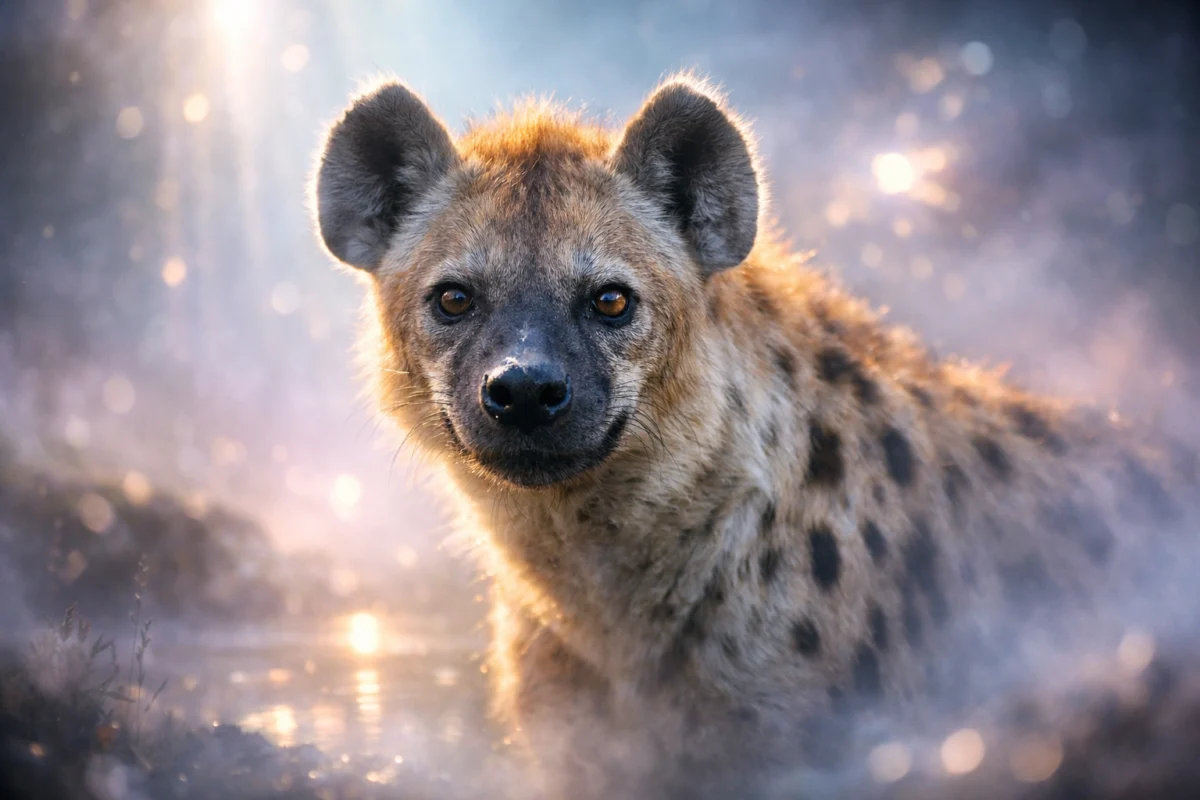
A hyena in a dream often symbolizes sharp survival instincts, social tension, opportunism, group pressure, nervous humor, or the part of you that notices weakness before others do. It can point to how you handle competition, criticism, fear, or messy social situations.
This symbol is not automatically bad. A hyena can represent danger, but it can also represent endurance, adaptability, clever timing, and the ability to use what is available. The meaning depends on what the hyena is doing, how you feel, and where the dream takes place.
Think of the hyena as a reusable dream symbol for instinct in social environments. It does not predict betrayal, illness, or failure. It asks you to look at your current relationship with trust, boundaries, survival, and group behavior.
Hyena Dream Examples
- You see a calm hyena walking beside you on a dirt road, and you feel alert but not afraid.
- A pack of hyenas surrounds you at night, laughing loudly while you look for a way out.
- You find an injured hyena hiding under a porch, and you are unsure whether to help it or keep your distance.
- A hyena appears between you and a friend during an argument, watching both of you closely.
- You see a white hyena standing in an empty workplace, school, or public building after everyone has left.
- You chase a hyena away from your home, bag, food, or personal belongings before it can take anything.
Hyena Dream Meaning: Good or Bad?
The condition of the hyena matters. A healthy, calm, or watchful hyena may suggest useful instincts and alertness. A sick, aggressive, starving, or injured hyena may point to stress, distrust, or a part of your life that feels neglected but still powerful.
Your agency in the dream also changes the meaning. If you observe the hyena from a safe place, you may be noticing a social pattern without being controlled by it. If the hyena chases you, blocks you, or steals something, the dream may show pressure, avoidance, or a fear of being taken advantage of.
Relationships and social context are especially important with this symbol. Hyenas are often imagined in groups, so dreams about them can reflect group dynamics, teasing, competition, alliances, or the feeling that someone is watching for your mistake. Overall, a hyena dream is neither good nor bad by itself; it is a signal to examine instinct, trust, and social pressure.
Positive Interpretation
If the calm hyena walks beside you, the dream may show that you are learning to use instinct without panic. Because the animal is near you but not attacking, the effect is a sense of guarded companionship. You may be becoming more comfortable with your sharper judgment.
If you chase the hyena away from your home or belongings, the dream can point to stronger boundaries. The cause is direct action: you notice a threat to your personal space and respond. The effect may be a growing ability to protect time, energy, money, privacy, or emotional peace.
If the hyena appears in a workplace, school, or public building and you stay calm, it may suggest that you can read social environments more clearly. The empty setting can make hidden pressure easier to notice. The dream may help you separate real responsibility from imagined judgment.
If you find an injured hyena and pause before acting, the positive meaning may involve careful compassion. You are not blindly rescuing or rejecting the animal. Because you assess the risk first, the dream may reflect mature judgment about when to help and when to keep distance. Even kindness needs a door with a working lock.
Negative Interpretation
If a pack of hyenas surrounds you at night, the dream may reflect feeling outnumbered, mocked, or watched by a group. The darkness adds uncertainty, and the pack increases the sense of social pressure. This does not prove that people are against you, but it can mirror how exposed you feel.
If the hyena stands between you and a friend during an argument, the dream may point to distrust, sarcasm, or a competitive tone entering the relationship. The animal acts as a symbolic divider. If the waking relationship is healthy, the dream may simply show fear of conflict rather than actual betrayal.
If the hyena is stealing food, a bag, or something personal, the dream may suggest worry about being drained or used. Food can symbolize energy and basic support, while a bag can symbolize identity, plans, or resources. The limit is important: the dream shows a feeling of loss or risk, not proof that someone is taking from you.
If the hyena is injured, starving, or sick, the negative meaning may involve neglected instincts turning anxious or defensive. You may be ignoring resentment, tiredness, competition, or a practical need. The weak condition of the animal suggests that the issue may not be strong on the surface, but it can still affect your mood and choices.
Different Cultures, Different Meanings
Modern symbolic context: In many current dream dictionaries, hyenas are linked with cunning, survival, laughter, scavenging, and group behavior. These are symbolic associations, not fixed meanings. Your personal experience with the animal matters more than any single interpretation.
Nature-based context: Real hyenas are social predators and scavengers with complex group behavior. In dreams, that can make them useful symbols for hierarchy, resourcefulness, teamwork, rivalry, or surviving on limited options. This is a symbolic bridge from animal behavior, not a biological claim about you.
Media and story context: If you know hyenas mainly from films, documentaries, cartoons, or scary stories, your dream may borrow that emotional tone. A comic hyena, a villain-like hyena, and a wild hyena can mean different things because your memory gives the symbol its emotional color.
Psychological Perspectives
From a symbolic or psychodynamic view, a hyena may represent an instinctive part of you that is clever, suspicious, hungry, or socially alert. A Jungian reading might treat it as a shadow-like figure, meaning a trait you do not fully accept, such as competitiveness, sarcasm, suspicion, or survival thinking. This does not make the trait evil; it means it may need awareness.
From a cognitive or emotional-processing view, the hyena may be the mind’s way of organizing recent stress. If you have dealt with gossip, pressure, deadlines, teasing, financial concern, or uncertainty, the brain may choose a watchful animal to carry those feelings. The dream condenses emotion into a vivid image so you can notice it.
From the continuity hypothesis, dreams often continue waking concerns in symbolic form. From threat-simulation theory, associated with Antti Revonsuo, a chasing or surrounding hyena may let the mind rehearse danger, escape, and boundary-setting. In this view, the dream is not predicting danger; it is modeling how threat feels and how you might respond.
Hyena Symbol Variations & Context Cues
- Condition: A calm hyena may point to controlled instinct, while an injured, starving, or rabid-looking hyena may suggest stressed or neglected needs.
- Color or material: A white hyena may highlight visibility, strangeness, or a message that stands out. A black hyena may emphasize fear, secrecy, or the unknown. A statue or toy hyena may suggest a contained or symbolic version of the issue.
- Number or scale: One hyena can show a focused concern or instinct. A pack can reflect group pressure, social comparison, or feeling outnumbered. A giant hyena may show that the issue feels larger than it is.
- Movement or behavior: Laughing, circling, stalking, biting, sleeping, or following each changes the meaning. Movement shows whether the pressure is active, passive, hidden, or approaching.
- Hidden, found, or lost: A hidden hyena can symbolize a concern you sense but cannot name. Finding one can mean you are discovering an uncomfortable truth. Losing sight of one may show uncertainty about where the pressure is coming from.
- Location or social setting: A hyena at home may involve personal boundaries. At work or school, it may involve status, competition, or judgment. In a wilderness setting, it may point to raw instinct and survival thinking.
Related Symbols & Common Combinations
- Wolf: A wolf often points to instinct, loyalty, danger, or independence, while a hyena more often adds themes of social pressure, opportunism, or nervous laughter.
- Dog: A dog can symbolize loyalty, protection, companionship, or trust. A hyena mixed with dog imagery may show confusion between friendship and suspicion.
- Lion: A lion may symbolize pride, authority, courage, or dominance. A hyena near a lion can highlight rivalry, hierarchy, or tension around power.
- Vulture: A vulture often relates to endings, cleanup, waiting, or using what remains. With a hyena, it may point to survival during scarcity or concern about people who benefit from weakness.
What You Should Do If You Dream About Hyena
Start with the hyena’s condition. Ask whether it looked healthy, wounded, starving, calm, or aggressive. A strong, calm hyena may suggest useful alertness. A distressed hyena may point to a neglected need, such as rest, honesty, food, money, space, or clearer boundaries.
Notice color and material. If the hyena was unusually white, black, golden, gray, mechanical, stuffed, or statue-like, that detail can show how your mind frames the symbol. A toy hyena may make the issue feel smaller or safer. A shadowy hyena may show that you do not yet fully understand the concern.
Count the hyenas and observe their scale. One hyena may relate to one person, one instinct, or one focused fear. A pack can reflect group pressure or many small worries acting together. A giant hyena may mean the feeling has grown in your mind, even if the waking issue is still manageable.
Review your interaction with the animal. Were you chased, bitten, watched, protected, followed, or ignored? Your role matters. Running may show avoidance. Standing still may show readiness. Feeding it may suggest you are giving energy to a difficult pattern, while guiding it may show that you are learning to direct instinct instead of fearing it.
Finally, connect the location to your waking life. A hyena at home may ask you to look at privacy and personal safety. At work or school, it may involve competition, reputation, or group judgment. In a desert, road, or wild place, it may point to self-reliance and survival choices.
Hyena Vs Similar Dreams
| Aspect | Hyena | Wolf | Dog | Vulture |
|---|---|---|---|---|
| Occasion/Age or Context | Often appears during social pressure, rivalry, boundary concerns, or times when you must be practical. | Often appears during independence, loyalty tests, leadership issues, or fear of being hunted. | Often appears when trust, friendship, protection, habit, or companionship is important. | Often appears near endings, waiting periods, cleanup, loss, or the need to use what remains. |
| Core Theme | Survival instinct, opportunism, social awareness, nervous humor, and group dynamics. | Wild instinct, freedom, loyalty, danger, and pack identity. | Loyalty, trust, guidance, protection, and emotional connection. | Release, patience, recycling, endings, and seeing value in what others avoid. |
| Typical Emotions | Unease, alertness, suspicion, fascination, pressure, or guarded confidence. | Fear, respect, loneliness, courage, or belonging. | Comfort, affection, worry, protection, or guilt. | Discomfort, acceptance, sadness, curiosity, or detachment. |
| Common Symbols | Packs, laughter, night, stolen food, dry land, arguments, or circling movement. | Forests, moonlight, howling, hunting, snow, or pack formation. | Leashes, homes, barking, playing, guarding, or following. | Skies, bones, deserts, cliffs, dead animals, or circling overhead. |
More in this category: Animals dreams.
Sources & Further Reading
- NINDS Brain Basics: Understanding Sleep Sleep science
- APA Dictionary of Psychology: Dream Analysis Psychology reference
- Dreaming and the Brain: From Phenomenology to Neurophysiology Research
- Sleep and Dreaming Are for Important Matters Research
- Sleep Foundation: Dreams Editorial background
- Sleep Health Foundation: Dreaming Sleep science