

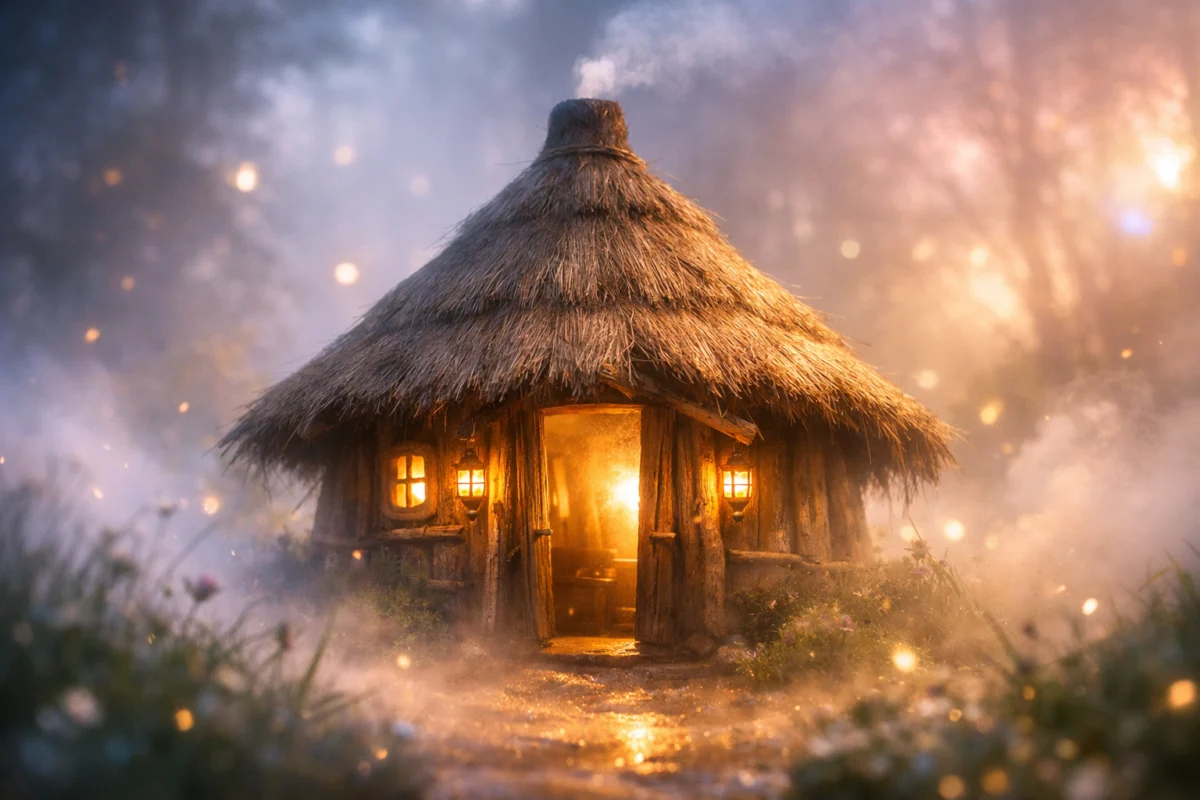
A hut in a dream often represents a simple shelter, a private inner space, or a temporary place where you step away from pressure. It is smaller and more basic than a house, so it often points to what feels essential, reduced, unfinished, or quietly protected in your life.
This symbol is not a fixed sign of poverty, isolation, or escape. A hut can feel peaceful, unsafe, useful, lonely, warm, or strange depending on its condition, location, and what you do inside or around it.
Think of the hut as a symbolic unit of shelter and simplicity. It may show how you are handling boundaries, privacy, survival, rest, emotional protection, or a need to return to basics without making the dream into a prophecy.
Hut Dream Examples
- You find a clean wooden hut near a lake, enter it calmly, and feel safe as the sun comes through the window.
- You are trapped in a broken hut during heavy rain, and the roof leaks while the walls shake.
- You see a small hut in the distance but cannot decide whether to walk toward it or stay where you are.
- You sit inside a hut with a friend, partner, or stranger, sharing food but not speaking much.
- You discover a grass hut on a beach, in a forest, or on a mountain path, and the place feels separate from normal life.
- You build, repair, burn, leave, or lock a hut, and the action feels more important than the hut itself.
Hut Dream Meaning: Good or Bad?
The meaning depends first on the hut’s condition. A sturdy, warm, clean hut may suggest safety, useful simplicity, emotional rest, or a return to basic needs. A damaged, dark, collapsing, or flooded hut may suggest stress, weak boundaries, or a coping space that no longer feels strong enough.
Your agency matters. If you choose to enter, build, repair, or leave the hut, the dream may show active decision-making. If you are trapped, lost, watched, or forced to stay there, the hut may reflect restriction, uncertainty, or a need to examine what is limiting your choices.
Relationships also change the meaning. Being alone in a hut can point to privacy or isolation. Sharing it with someone may highlight trust, distance, quiet support, or awkward emotional closeness. A hut dream is good or bad depending on whether the hut protects you, limits you, or asks you to change how you use your inner shelter.
Positive Interpretation
If you dream of a clean wooden hut near calm water, the dream may show that simple conditions help you feel emotionally settled. The basic shelter plus the peaceful setting can suggest that you do not need every detail controlled before you can rest.
If you are building or repairing a hut, the positive meaning may involve self-reliance. Because you are improving the shelter with your own effort, the dream can reflect practical growth, stronger boundaries, or a willingness to rebuild one small piece of life at a time.
If you share food with someone inside a hut, the dream may point to quiet trust. The hut is small, so the relationship is close and stripped of distractions. This can suggest that simple gestures, not dramatic speeches, are carrying the emotional meaning.
If you find a hut during a journey through a forest, beach, or mountain area, it may symbolize a needed pause. The setting shows movement or challenge, while the hut offers a stop for protection. The effect is a dream image of temporary recovery before you continue.
Negative Interpretation
If the hut is leaking, shaking, or collapsing, it may reflect a support system that feels too fragile. This does not mean disaster is coming. It more likely shows that a method of coping, resting, or protecting yourself may need attention.
If you are trapped inside the hut, the dream can suggest that privacy has turned into confinement. A place meant to shelter you may now feel too small. The evidence is stronger if the dream includes locked doors, blocked windows, or a strong wish to escape.
If the hut is dark, hidden, or hard to reach, it may point to uncertainty around a private issue. However, this is weaker evidence if you felt curious, peaceful, or invited. Darkness in dreams can mean fear, but it can also mean mystery, rest, or something not yet understood.
If you burn, abandon, or destroy the hut, the dream may show rejection of an old way of protecting yourself. This can feel negative if the action brings panic or regret. If the action brings relief, the same image may mean release from something too small or outdated.
Different Cultures, Different Meanings
Modern symbolic context: In many contemporary dream readings, a hut is interpreted as a simple shelter rather than a grand life structure. Personal context matters more than any universal folklore rule.
Rural and survival associations: If you connect huts with cabins, shelters, camps, or village life, the dream may focus on resourcefulness, basic needs, or closeness to nature. This depends on your real memories and feelings about such places.
Religious or retreat settings: Some people may associate a hut with retreat, prayer, solitude, or voluntary simplicity. This meaning is relevant only if those themes are already meaningful to you in waking life.
Travel and temporary shelter: A hut in a remote location can reflect being between stages. It may not be a permanent home symbol. It can represent a short stop, a threshold, or a protective pause while you are in transition.
Psychological Perspectives
From a symbolic or psychodynamic view, a hut can represent a smaller version of the self, especially the part that wants privacy, safety, and reduced demands. Jungian-style interpretation might see it as an inner refuge or a humble dwelling of the psyche, while a Freudian reading would focus more on personal associations and hidden wishes rather than a single fixed meaning.
From a cognitive or emotional-processing view, the hut may be your dreaming mind organizing feelings about safety, limits, and available resources. A simple shelter can help the dream show whether you feel prepared, exposed, protected, or emotionally under-equipped.
From the continuity hypothesis, dreams often continue waking concerns in symbolic form. If you are dealing with stress, moving, simplifying, seeking privacy, or managing social pressure, a hut may become a dream setting for those themes. Threat-simulation ideas, such as those linked with Revonsuo, may apply if the hut is unsafe, attacked, or hard to escape.
Hut Symbol Variations & Context Cues
- Condition: A strong hut may suggest stability and useful boundaries, while a broken hut may point to weak support, stress, or a need for repair.
- Color or material: Wood, grass, mud, stone, metal, white walls, dark walls, or bright paint can shift the tone toward naturalness, heaviness, purity, secrecy, warmth, or discomfort.
- Number or scale: One tiny hut may suggest solitude or minimalism. Many huts may point to community, shared conditions, or repeating patterns across different areas of life.
- Movement or behavior: Building, cleaning, locking, entering, leaving, burning, or hiding in a hut shows how you are acting toward shelter, privacy, and personal limits.
- Hidden, found, or lost: A hidden hut may suggest a private resource. A found hut may point to unexpected support. A lost hut can suggest difficulty returning to rest or safety.
- Location and social setting: A hut in a forest, desert, beach, village, snowfield, or crowded city changes the meaning by showing what surrounds your need for shelter.
Related Symbols & Common Combinations
- House: A house usually represents a fuller sense of self, home, identity, or life structure, while a hut points to the simpler and more exposed version.
- Cabin: A cabin often adds themes of retreat, wilderness, rest, or escape from routine, especially when it feels cozy or remote.
- Forest: A forest around a hut can suggest uncertainty, exploration, instinct, or being away from familiar social rules.
- Roof: The roof of the hut highlights protection. A leaking or missing roof often makes the dream focus on exposure and emotional vulnerability.
What You Should Do If You Dream About Hut
Start with the hut’s condition. Ask whether it was strong, clean, broken, crowded, empty, warm, cold, open, or locked. This gives you the clearest clue about whether the dream is showing useful shelter or a fragile coping space.
Notice the color and material. A wooden hut may feel natural and grounded, while a metal hut may feel practical but cold. A bright hut may feel welcoming, while a black or shadowed hut may suggest privacy, uncertainty, or something not fully seen.
Look at number and scale. A very tiny hut may show that your space feels limited, but it can also mean you are focusing on essentials. Many huts may suggest a group situation, shared living patterns, or several small areas of life needing attention.
Pay close attention to your interaction. Entering, fixing, cleaning, decorating, locking, escaping, or destroying the hut says more than the hut alone. The action reveals whether you are protecting, improving, avoiding, leaving, or changing a boundary.
Finally, place the hut in its setting. A hut by the sea, in a forest, near family, beside strangers, or far from roads gives the dream its social and emotional background. The hut is the shelter, but the location shows what you are sheltering from or moving toward.
Hut Vs Similar Dreams
| Aspect | Hut | House | Cabin | Tent |
|---|---|---|---|---|
| Occasion/Age or Context | Often appears during simple, temporary, private, or stripped-back life phases. | Often appears when identity, family life, personal structure, or long-term security is central. | Often appears in retreat, wilderness, holiday, escape, or quiet recovery contexts. | Often appears during travel, transition, uncertainty, or temporary protection. |
| Core Theme | Basic shelter, simplicity, privacy, and essential emotional protection. | Self-structure, belonging, memory, stability, and inner life. | Withdrawal, nature, rest, independence, and distance from routine. | Flexibility, exposure, movement, and short-term support. |
| Typical Emotions | Calm, lonely, safe, exposed, humble, or uncertain. | Comfort, anxiety, nostalgia, pride, fear, or responsibility. | Peace, isolation, adventure, relief, or unease. | Freedom, vulnerability, excitement, discomfort, or alertness. |
| Common Symbols | Wood, grass, smoke, small door, dirt floor, leaking roof, nearby path. | Rooms, stairs, basement, attic, doors, windows, family objects. | Fireplace, forest, snow, lake, logs, porch, distant road. | Poles, fabric, campsite, wind, backpack, ground, open sky. |
More in this category: Locations dreams.
Sources & Further Reading
- NINDS Brain Basics: Understanding Sleep Sleep science
- APA Dictionary of Psychology: Dream Analysis Psychology reference
- Dreaming and the Brain: From Phenomenology to Neurophysiology Research
- Sleep and Dreaming Are for Important Matters Research
- Sleep Foundation: Dreams Editorial background
- Sleep Health Foundation: Dreaming Sleep science