

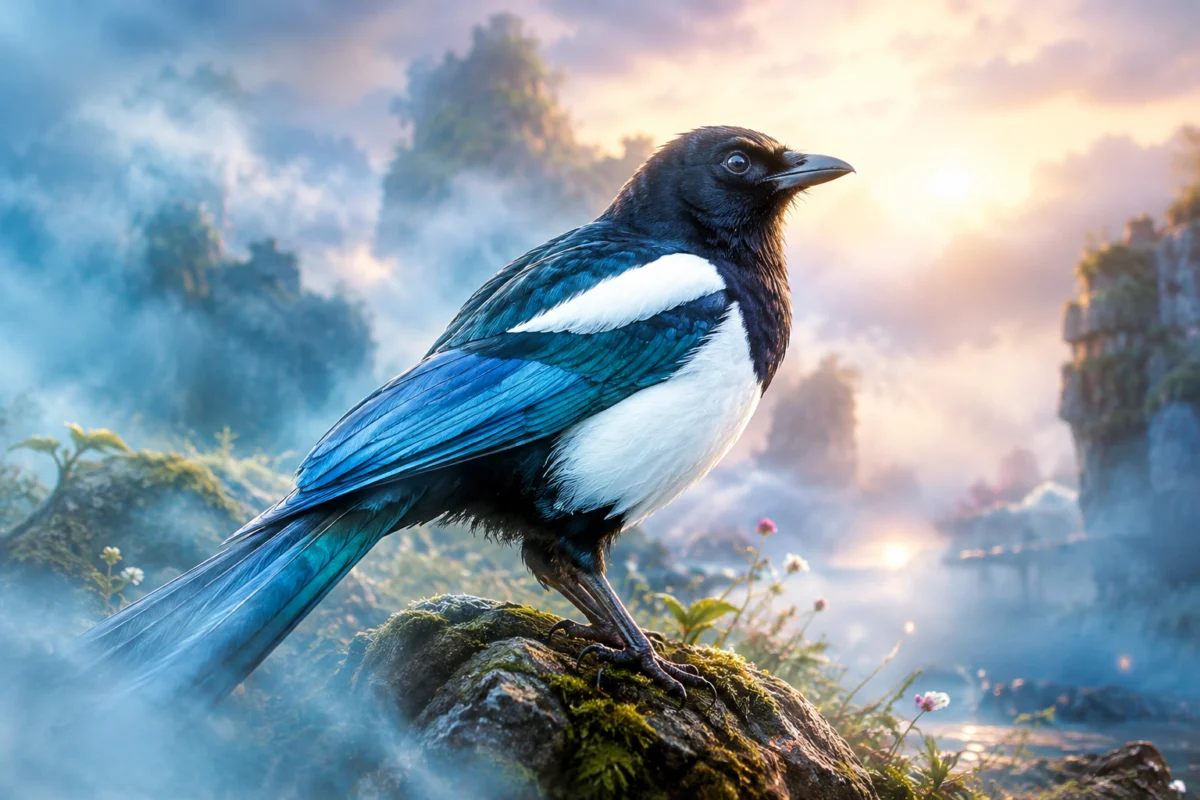
A magpie in a dream may draw your attention to curiosity, communication, alertness, or the things you notice and value. Its meaning depends on what the bird does and how you feel about it.
Magpies are recognizable, intelligent birds often associated in popular imagery with collecting or noticing bright objects. In a dream, these associations can point toward an idea, detail, or opportunity that has caught your attention.
A magpie is not a prediction, diagnosis, or symbol with one fixed meaning. Treat it as a reusable symbol, and consider your personal associations and the dream’s specific details.
Magpie Dream Examples
- A healthy magpie lands beside you and watches calmly. The quiet encounter may reflect curiosity or a new detail you are ready to notice.
- A magpie is trapped in a cage and repeatedly beats its wings. This may mirror a feeling of restriction, frustration, or concern about someone’s freedom.
- You see a magpie carrying a bright object, but cannot tell where it is taking it. The image may suggest an interesting idea or desire whose importance is still unclear.
- A magpie sits between you and a friend while you try to speak. The bird may represent distraction, unspoken thoughts, or attention shifting within the interaction.
- A magpie appears on a familiar rooftop during a storm. The setting may connect everyday concerns with a period that feels unsettled or demanding.
- You follow a magpie through a garden and find a small object where it stops. This action may reflect active searching, noticing clues, or following your curiosity.
Magpie Dream Meaning: Good or Bad?
The bird’s condition can shape the tone. A lively magpie may feel encouraging or simply interesting, while an injured or trapped one may bring concern. These details describe the dream’s emotional atmosphere, not a forecast.
Your agency matters too. Watching from a distance differs from feeding, chasing, rescuing, or avoiding the bird. Your actions can point to how you are responding to curiosity, distraction, or an issue that has drawn your attention.
Relationships and social context can add another layer if other people are present. A magpie interrupting a conversation may reflect divided attention, but it does not prove that anyone is being dishonest. A magpie dream is neither inherently good nor bad; its meaning depends on its condition, your actions, and the surrounding context.
Positive Interpretation
In the first example, the healthy bird lands calmly and holds your attention. Because the encounter is peaceful rather than threatening, it may reflect openness to a new idea or a useful detail you had previously overlooked.
In the third example, the magpie carries a bright object whose destination is unknown. The object can stand for something that feels valuable or intriguing, while the uncertainty suggests you are still working out what it means to you. Curiosity can be useful without requiring an immediate decision.
In the sixth example, you choose to follow the bird and discover an object. The action creates a cause-and-effect pattern: you pay attention, continue exploring, and find something. In waking life, this may echo a willingness to investigate a question or notice an overlooked resource.
If the magpie in the second example is freed from its cage, that change can make the scene hopeful. Your involvement may reflect a wish to restore choice or make room for independent thinking. It is the change in the dream, rather than the bird alone, that supports this interpretation.
Negative Interpretation
In the second example, a bird repeatedly striking the cage may be upsetting to watch. If the scene leaves you tense or helpless, it can echo a situation that feels restricted. The image alone cannot establish what is causing that feeling or whether someone is actually at risk.
In the fourth example, the bird sits between you and a friend while you try to speak. If the conversation feels strained, the magpie may represent distraction or difficulty giving each other attention. It is not evidence of betrayal, and the dream may simply reflect a moment when communication felt interrupted.
In the fifth example, a familiar roof and a storm bring together a recognizable setting and unsettled weather. This may resemble ordinary responsibilities feeling harder to manage during a busy or uncertain period. The weather is a dream cue, not a reliable sign that trouble is coming.
If the calm encounter in the first example leaves you uneasy, the bird’s direct gaze might feel intrusive rather than welcoming. That reaction could suggest discomfort with being observed or with something demanding your attention. A single dream image is weak evidence for any lasting problem, so give more weight to repeated patterns and your own associations.
Different Cultures, Different Meanings
There is no single cultural interpretation that should be applied to every magpie dream. Associations vary by place, personal experience, and the stories or images someone has encountered. Your own response to the bird may be more relevant than a general symbolic claim.
As a modern symbolic note, popular images sometimes portray magpies as curious birds attracted to bright or unusual objects. If that image is familiar to you, a dream may bring up collecting, noticing, or valuing something. This is an interpretive association, not a universal belief about magpies.
In everyday life, a magpie may simply be a bird you have seen recently, heard outside, or encountered in media. If so, a recent memory can help explain its appearance without requiring a deeper cultural meaning. The dream’s action and emotional tone still offer useful context.
Psychological Perspectives
From a symbolic or psychodynamic perspective, the magpie can be explored as an image linked to your personal associations. You might connect it with curiosity, watchfulness, collecting, or a particular memory. This approach is a way to reflect, not proof that the bird represents one hidden meaning.
From a cognitive and emotional-processing perspective, dreams can combine recent impressions, memories, and feelings. A magpie you saw during the day might appear beside a familiar person or place because dreams can bring separate material together. Your emotional response and the details that stand out may be more informative than a universal symbol list.
The continuity hypothesis considers how dream content may relate to waking concerns and experiences. Threat-simulation approaches, including work associated with Antti Revonsuo, examine how some dreams represent possible threats, but a magpie is not inherently threatening. A trapped or attacking bird may reflect a tense scene; a calm one may not. These are perspectives for interpretation, not a diagnosis or a way to predict events.
Magpie Symbol Variations & Context Cues
- Condition: A healthy, active bird may suggest alertness or interest; an injured, dead, or trapped bird may bring up vulnerability or restriction. Your feelings determine the emphasis.
- Color or material: Notice the bird’s actual coloring and any unusual material, such as a metallic-looking feather. A bright object in its beak may draw attention to something you consider valuable, but color alone has no fixed meaning.
- Number or scale: One magpie can make the encounter feel personal, while a flock may make it feel busy or social. An unusually large bird may make its qualities seem more important in the dream.
- Movement or behavior: A bird that watches, calls, flies away, steals, or approaches creates different scenes. Ask whether its behavior feels inviting, disruptive, threatening, or simply natural.
- Hidden, found, or lost: A magpie appearing from hiding may bring an overlooked detail into focus. Finding or losing an object connected to it may reflect changing attention or uncertainty about what matters.
- Location or social setting: A magpie at home, work, outdoors, or among friends can connect the image to that setting. Other people’s reactions may show how social attention or shared concerns shape the dream.
Related Symbols & Common Combinations
- Bird: A useful broader symbol for flight, observation, and movement; compare the general bird image with the magpie’s specific behavior.
- Crow: Another noticeable bird that may bring attention to observation, intelligence, or unease, depending on the dream’s tone.
- Feather: A feather can focus the dream on a small detail, a trace of a bird, or something delicate that you have noticed.
- Treasure: An object the magpie carries or finds may connect the bird with value, desire, or something you are trying to identify.
What You Should Do If You Dream About Magpie
Start with the bird’s condition. Write down whether it appeared healthy, injured, calm, or trapped, and note your first reaction. This can help you distinguish a curious encounter from a scene that felt difficult.
Record its coloring and any objects or materials around it. If a bright item stood out, ask what it reminded you of and whether you currently regard something as precious, distracting, or worth pursuing. Do not assume a color has a universal meaning.
Consider number and scale. One bird, a flock, or an unusually large magpie may change the dream’s sense of focus or intensity. Connect that difference to what you were thinking about, rather than treating it as a measure of future events.
Describe your interaction with the bird in plain terms. Did you watch it, follow it, feed it, avoid it, or try to help? Your response may offer a clearer clue about how you are approaching an interesting, disruptive, or uncertain issue.
Finally, note the location and who else was present. A familiar place can link the image to ordinary routines, while a social setting may make attention or communication relevant. Compare the dream with recent experiences, and keep any interpretation tentative.
Magpie Vs Similar Dreams
| Aspect | Magpie | Crow | Raven | Jay |
|---|---|---|---|---|
| Occasion/Age or Context | Often linked in popular imagery with noticing or collecting; personal context matters. | May reflect a familiar encounter with a conspicuous bird. | May draw attention to a striking, solitary bird or recent impression. | May connect with a colorful bird, a call, or a lively outdoor scene. |
| Core Theme | Curiosity, attention, communication, or value. | Observation, adaptability, or the feeling created by the scene. | Presence, mystery, or a memorable image. | Alertness, activity, or visual distinction. |
| Typical Emotions | Interest, amusement, unease, or distraction. | Curiosity, wariness, or calm. | Awe, uncertainty, or neutrality. | Energy, surprise, or interest. |
| Common Symbols | Bright objects, feathers, rooftops, or a flock. | Calls, groups, open spaces, or found objects. | Dark feathers, flight, solitary perches, or wide skies. | Color, branches, calls, or quick movement. |
More in this category: Animals dreams.
Sources & Further Reading
- NINDS Brain Basics: Understanding Sleep Sleep science
- APA Dictionary of Psychology: Dream Analysis Psychology reference
- Dreaming and the Brain: From Phenomenology to Neurophysiology Research
- Sleep and Dreaming Are for Important Matters Research
- Sleep Foundation: Dreams Editorial background
- Sleep Health Foundation: Dreaming Sleep science