

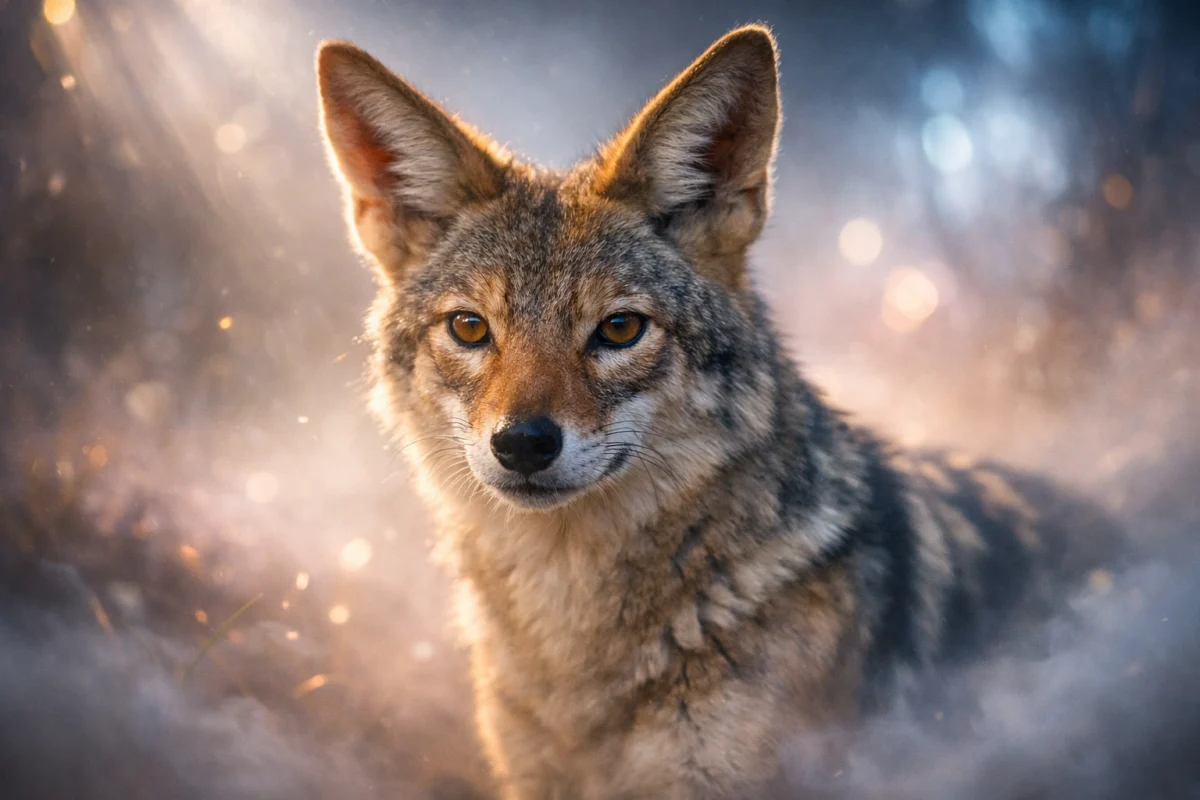
A jackal in a dream often points to alertness, survival instinct, social awareness, and the need to read a situation carefully. It is not a fixed sign of danger or deceit. It is a symbolic image that changes meaning based on what the jackal does and how you feel around it.
Because jackals are known as adaptable scavengers and hunters, your dream may be showing how you handle limited resources, uncertain people, or changing conditions. The symbol can ask, “Are you being clever, cautious, or too guarded?” One small jackal can carry a lot of meaning, which is efficient dream budgeting.
The main boundary is context. A calm jackal beside you is different from a starving jackal following you at night. Look at condition, location, behavior, number, color, and your interaction before deciding what the dream is really highlighting.
Jackal Dream Examples
- You see a healthy golden jackal walking beside you on a quiet road, and you feel protected rather than afraid.
- A thin, aggressive jackal snarls outside your door while you try to keep it from entering your house.
- A jackal watches you from the edge of a field, neither coming closer nor running away.
- You and a friend feed a jackal together, but your friend seems more comfortable with it than you do.
- A pack of jackals moves through an empty city street at dusk, and you hide in a doorway to observe them.
- You chase a wounded jackal through a dry landscape, then stop when you realize it is only trying to escape.
Jackal Dream Meaning: Good or Bad?
A jackal dream can feel positive when the animal is healthy, calm, distant, or cooperative. In this form, it may reflect useful instincts, practical thinking, and the ability to adapt without losing control. The condition of the jackal often shows whether the instinct feels balanced or pressured.
Agency matters. If you choose how to respond, the dream may suggest growing confidence in uncertain circumstances. If the jackal corners you, chases you, or enters without permission, the dream may point to pressure, suspicion, or a situation where you feel watched or tested.
Relationships and social setting also change the meaning. A jackal near friends, coworkers, or strangers may reflect group dynamics, trust, competition, or the need to notice hidden motives. Clear answer: a jackal dream is not simply good or bad, but usually shows how you are handling instinct, caution, and social awareness.
Positive Interpretation
If the jackal walks beside you on a quiet road, the dream may show a helpful instinct moving with you instead of against you. The calm movement suggests that you are learning to trust your own awareness. Because the jackal is not attacking, the effect may be a sense of practical protection as you move through an uncertain stage.
If the jackal watches from the edge of a field, it may represent observation rather than threat. The distance gives you space to think. This can point to a situation where you are wise to pause, gather information, and avoid rushing into a decision before the full landscape is clear.
If you and a friend feed a jackal together, the dream may show a shared attempt to understand something instinctive or difficult. Because feeding is an interaction, not a fight, the effect may be cooperation around a practical problem. It can also suggest that someone else is more comfortable with ambiguity, risk, or negotiation than you are.
If you stop chasing a wounded jackal once you realize it is trying to escape, the dream may reflect compassion toward a part of yourself or someone else that acts defensively under pressure. The cause is recognition. The effect is a shift from control to understanding, which can make the symbol feel healing rather than threatening.
Negative Interpretation
If a thin, aggressive jackal snarls outside your door, the dream may point to a boundary issue. The door suggests your private space, home life, or personal limits. Because the jackal is hungry and hostile, the dream may reflect a demand, habit, or social pressure that feels draining. Still, this does not prove that a real person is harmful.
If a pack of jackals moves through an empty city street, the dream may highlight group pressure, social anxiety, or a feeling that normal order has changed. The city setting brings the symbol into public life, work, reputation, or community. The pack can intensify the feeling of being outnumbered, especially if you hide rather than engage.
If the jackal watches you but does not act, the meaning is weaker and more ambiguous. It may show suspicion, anticipation, or your own habit of scanning for problems. However, if there is no attack, no chase, and no clear emotional distress, it is best not to overread it as a warning.
If you chase a wounded jackal, the negative side may be about pursuing a problem too hard. You may be trying to force an answer from something fragile, defensive, or not ready to be handled. The dream can suggest that pressure may create more fear, especially when the image shows injury or exhaustion.
Different Cultures, Different Meanings
Ancient Egyptian context: Jackal-like canids are strongly associated with funerary imagery, especially the god Anubis, who is linked with burial, protection of the dead, and transition. In a modern dream, this does not automatically mean death. It may symbolically point to endings, thresholds, protection, or respect for what is being left behind.
Modern symbolic context: In many contemporary dream readings, a jackal can represent adaptability, opportunism, caution, or survival intelligence. This is a general symbolic association, not a universal cultural rule. Your personal feelings about jackals matter more than a fixed dictionary meaning.
Natural behavior context: Jackals are often understood as resourceful animals that can scavenge, hunt, and live near changing environments. In dreams, this can translate into practical questions about how you use what is available, how you respond to scarcity, and whether you are acting from wisdom or fear.
Psychological Perspectives
From a symbolic or psychodynamic view, a jackal may represent an instinctive part of you that knows how to survive in uncertain conditions. A Jungian reading might see the jackal as a shadow-like figure if it carries traits you dislike, such as cunning, suspicion, or opportunism. This does not mean those traits are bad. It may mean they need conscious understanding.
From a cognitive or emotional-processing view, the jackal may be your dreaming mind organizing recent feelings about trust, risk, competition, or social signals. Hobson’s work on dreaming emphasized the brain’s active construction of dream experience. In simple terms, your mind may use the jackal image because it fits a current emotional pattern.
From the continuity hypothesis or threat-simulation view, dreams often echo waking concerns. Revonsuo’s threat-simulation theory suggests some dreams rehearse possible dangers or responses. A jackal dream may therefore stage caution, boundary defense, or group awareness, especially if you have recently felt uncertain, watched, tested, or outnumbered.
Jackal Symbol Variations & Context Cues
- Condition: A healthy jackal may suggest balanced instinct and adaptability, while a sick, starving, or wounded jackal may point to pressured survival patterns or neglected needs.
- Color or material: A golden jackal can feel alert and natural, a black jackal may feel hidden or unknown, and a statue or mask of a jackal may suggest symbolism, role-playing, or emotional distance.
- Number or scale: One jackal often points to a specific instinct or person-like presence, while a pack can suggest group pressure, social complexity, or amplified fear.
- Movement or behavior: A watching jackal may signal observation, a following jackal may show ongoing concern, and a biting jackal may show a boundary that feels violated.
- Hidden, found, or lost: Finding a jackal can mean discovering a survival skill, hiding from one can show avoidance, and losing sight of one may suggest uncertainty about a risk.
- Location or social setting: A jackal in your home points toward private limits, in a workplace toward strategy or competition, and in a wilderness toward raw instinct and independence.
Related Symbols & Common Combinations
- Wolf: A wolf dream often focuses on wild power, pack identity, and deep instinct, while a jackal is usually more about adaptability, caution, and opportunistic survival.
- Fox: A fox can highlight cleverness, strategy, and evasion, especially in social or mental situations. With a jackal, it may sharpen the theme of reading motives.
- Dog: A dog often relates to loyalty, protection, and companionship. A jackal beside a dog may contrast trust with caution or comfort with suspicion.
- Desert: A desert setting can intensify themes of scarcity, endurance, loneliness, and resourcefulness. A jackal in a desert often asks how you survive with limited support.
What You Should Do If You Dream About Jackal
Start with the jackal’s condition. Was it healthy, wounded, starving, calm, or aggressive? A healthy jackal may invite you to trust your practical instincts. A distressed jackal may ask where you feel depleted, defensive, or forced to make do with too little.
Next, note color or material. A natural-colored jackal may keep the meaning close to instinct and environment. A black, white, golden, carved, painted, or masked jackal may add a layer of mystery, purity, value, performance, or symbolic distance. Do not force a meaning. Use the color as a clue, not a verdict.
Look at number and scale. One small jackal may represent a manageable concern or quiet intuition. A huge jackal or pack may show that the issue feels larger than normal. If many jackals appear, ask whether group dynamics, workplace pressure, social comparison, or public judgment have been active in your waking life.
Review your interaction with the jackal. Feeding it, following it, fighting it, hiding from it, or walking beside it all create different meanings. If you cooperate with the jackal, the dream may show integration of instinct. If you fight it, the dream may show conflict with suspicion, need, or self-protection.
Finally, place the jackal in its setting. A jackal at your door may be about personal boundaries. A jackal in a field may be about observation and choice. A jackal in a city may connect to social systems, work, or public identity. The setting tells you where the symbol is asking for attention.
Jackal Vs Similar Dreams
| Aspect | Jackal | Wolf | Fox | Dog |
|---|---|---|---|---|
| Occasion/Age or Context | Often appears during uncertain, competitive, or resource-limited situations where you must read the room carefully. | Often appears when themes of power, belonging, independence, or pack identity are active. | Often appears when strategy, cleverness, secrecy, or quick thinking is central. | Often appears in dreams about loyalty, protection, friendship, duty, or familiar emotional bonds. |
| Core Theme | Adaptability, caution, survival instinct, and social awareness. | Wild instinct, strength, group loyalty, and personal freedom. | Cunning, agility, problem-solving, and hidden motives. | Trust, companionship, obedience, protection, and emotional attachment. |
| Typical Emotions | Watchfulness, suspicion, curiosity, caution, or uneasy respect. | Awe, fear, strength, loneliness, or belonging. | Amusement, doubt, alertness, uncertainty, or admiration. | Comfort, love, fear of loss, safety, or responsibility. |
| Common Symbols | Desert, dusk, scavenging, packs, doors, fields, bones, distant howls. | Forest, moon, snow, pack, teeth, running, mountains. | Hedges, paths, tricks, red fur, stolen objects, quick movement. | Home, leash, collar, barking, guarding, playing, following. |
More in this category: Animals dreams.
Sources & Further Reading
- NINDS Brain Basics: Understanding Sleep Sleep science
- APA Dictionary of Psychology: Dream Analysis Psychology reference
- Dreaming and the Brain: From Phenomenology to Neurophysiology Research
- Sleep and Dreaming Are for Important Matters Research
- Sleep Foundation: Dreams Editorial background
- Sleep Health Foundation: Dreaming Sleep science