

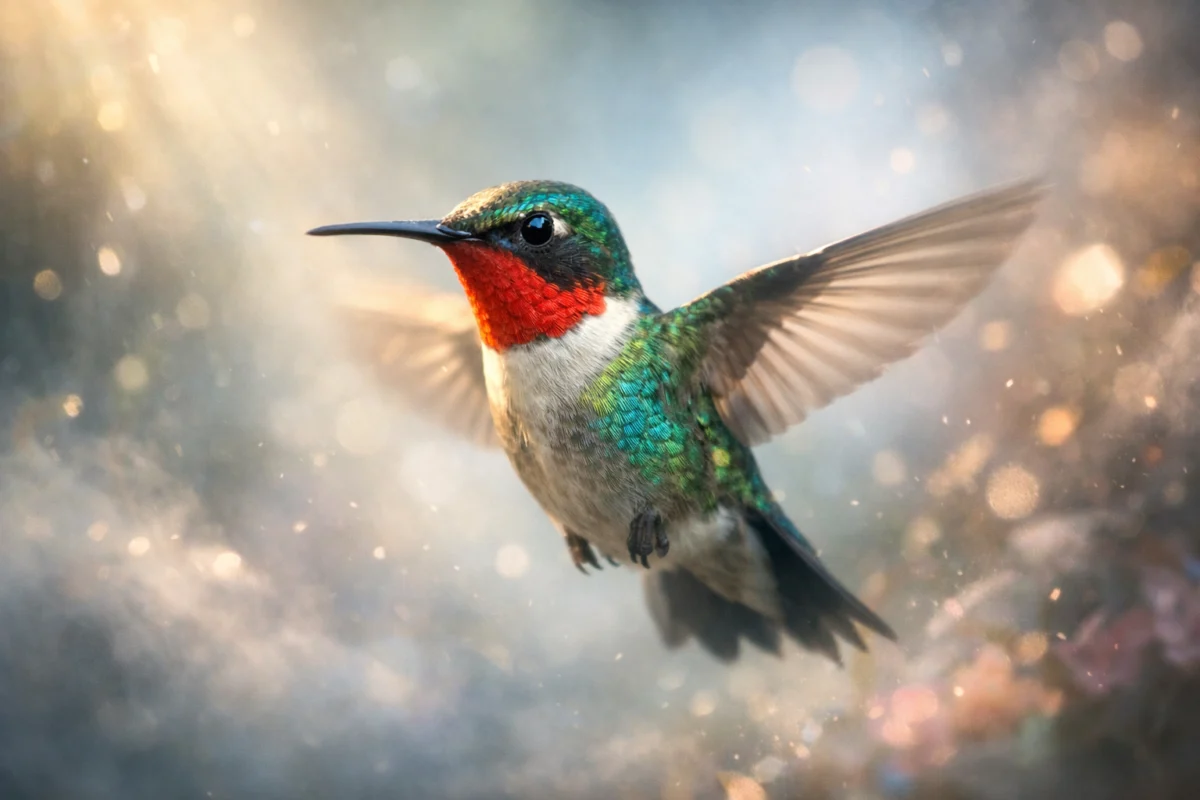
A hummingbird in a dream often points to quick attention, lightness, small sources of joy, and the way you move between tasks, people, or feelings. Because a hummingbird is tiny but highly active, it can symbolize something that looks small from the outside but takes a surprising amount of energy inside you.
This symbol can also show how you relate to beauty, sweetness, timing, and emotional nourishment. A dream hummingbird may appear when you are noticing brief moments, trying to stay flexible, or feeling pulled in many directions at once.
Its meaning depends on the dream context. A calm hummingbird near flowers carries a different message than a trapped, injured, or frantic one. Treat the hummingbird as a symbolic clue, not as a prediction or fixed outcome.
Hummingbird Dream Examples
- You see a bright green hummingbird drinking nectar from red flowers in a sunny garden, and you feel peaceful.
- A hummingbird flies inside your room and cannot find the open window, making you feel worried and rushed.
- You watch several hummingbirds hover around a feeder, but you are unsure whether they are calm or competing.
- A hummingbird lands on your hand while someone close to you stands nearby, and both of you stay quiet.
- You find a tiny hummingbird nest hidden in a tree beside your workplace, school, or another daily setting.
- You try to photograph a hummingbird, but it moves too fast and keeps disappearing from the frame.
Hummingbird Dream Meaning: Good or Bad?
A hummingbird dream is often positive when the bird looks healthy, colorful, free, and connected with flowers, sunlight, or open air. These cues can suggest emotional refreshment, curiosity, agility, or a small but meaningful source of happiness.
The dream can feel more difficult when the hummingbird is trapped, exhausted, injured, chased, or moving in a frantic pattern. In that case, the symbol may point to nervous energy, overcommitment, distraction, or a feeling that something delicate needs protection.
Relationships and social context matter too. A hummingbird near another person may reflect brief connection, careful communication, attraction to someone’s energy, or the need to give a relationship more space. Overall, a hummingbird dream is neither good nor bad by itself, but it usually asks you to notice how your energy, attention, and small joys are being used.
Positive Interpretation
If you dream of a bright hummingbird drinking nectar from flowers, the image may show that you are finding nourishment in small experiences. The cause is simple: the bird moves toward what feeds it. The effect in your waking life may be a reminder to notice small pleasures, meaningful routines, or moments that restore your mood without needing a dramatic change.
If the hummingbird lands on your hand, the dream can suggest a gentle connection that requires trust and stillness. Because the bird chooses to come close, the effect may be a feeling that patience, quiet attention, or respectful space is helping a bond develop. This does not have to be romantic. It may apply to friendship, teamwork, family, or your relationship with your own sensitive side.
If you find a hidden hummingbird nest in a familiar setting, the dream may point to potential that is small, private, and still developing. Since a nest is a place of care and growth, the effect may be that you are becoming aware of a quiet project, skill, idea, or emotional need that has been forming in the background of daily life.
If several hummingbirds hover around a feeder and the mood feels lively rather than tense, the dream may reflect social energy, shared resources, or creative exchange. The cause is the gathering around nourishment. The effect may be that you are learning how to enjoy activity, variety, and community without losing your own rhythm.
Negative Interpretation
If a hummingbird is trapped indoors and cannot find the window, the dream may reflect blocked movement or mental restlessness. The bird’s quick motion shows energy, but the closed space limits it. This can point to a situation where you are trying hard but using your effort in a place that does not give you enough room.
If you try to photograph a hummingbird and it keeps disappearing, the dream may show frustration with capturing something brief. You may be trying to define a feeling, opportunity, or person too quickly. The evidence is stronger if the dream feels tense, disappointing, or obsessive. If it feels playful, the meaning may simply be that some experiences are better lived than controlled. Tiny bird, tiny camera problem.
If hummingbirds around a feeder seem aggressive or crowded, the dream may suggest competition for attention, energy, time, or approval. This interpretation depends on the emotional tone. If you felt anxious, excluded, or pressured, the dream may be highlighting how social or work settings make you feel rushed or compared.
If the hummingbird appears weak, dull, injured, or unable to fly, it may symbolize depleted vitality or a fragile part of your life that needs attention. This is not a medical sign and should not be treated as a diagnosis. In dream language, the weakened bird more often reflects a perceived loss of lightness, motivation, or emotional ease.
Different Cultures, Different Meanings
Modern symbolic context: In many contemporary dream dictionaries, hummingbirds are linked with joy, speed, beauty, and the ability to draw sweetness from life. This is a broad symbolic association based on the bird’s visible behavior, not a universal rule.
Nature and ecology context: Hummingbirds are known for hovering, rapid movement, and feeding from flowers. In dreams, these real traits can become symbols for focus, effort, delicacy, and the exchange between energy and nourishment.
Personal and regional context: If you live where hummingbirds are common, the dream may feel familiar and ordinary. If you rarely see them, the image may stand out as unusual or special. Your personal memory of the bird usually matters more than any general cultural meaning.
Psychological Perspectives
From a symbolic or psychodynamic view, a hummingbird may represent a lively but delicate part of you. In a Jungian sense, it can act as an image of quick inner movement, beauty, or a small messenger from the unconscious. The key is not to force a fixed meaning, but to ask what the bird’s behavior reveals about your current emotional pattern.
From a cognitive or emotional-processing view, the dream may combine recent images, feelings, and concerns into one compact symbol. If you have been busy, overstimulated, or searching for brief relief, the hummingbird’s speed and feeding behavior may mirror how your mind is sorting attention, desire, and emotional reward during sleep.
From the continuity hypothesis, dreams often continue themes from waking life. A hummingbird may reflect your real daily pace, your need for small rewards, or your effort to stay flexible. From a threat-simulation angle, a trapped or chased hummingbird may rehearse feelings of vulnerability, pressure, or escape without predicting anything literal.
Hummingbird Symbol Variations & Context Cues
- Condition: A healthy hummingbird often suggests vitality and lightness, while an injured, tired, or trapped one may point to depleted energy or restricted freedom.
- Color or material: Bright green, blue, red, or iridescent colors can highlight beauty, emotion, and attention. A glass, metal, or toy hummingbird may suggest an idea of joy rather than a living feeling.
- Number or scale: One hummingbird may focus on a single feeling or task. Many hummingbirds can show social activity, scattered attention, or shared nourishment. An oversized hummingbird may make a small issue feel unusually important.
- Movement or behavior: Hovering can mean waiting, focus, or hesitation. Darting can show speed and distraction. Feeding can suggest nourishment. Attacking can reflect pressure or overstimulation.
- Hidden, found, or lost: A hidden nest may point to private growth. A found hummingbird can suggest rediscovered joy. A lost or vanished bird may show that a brief opportunity, mood, or connection feels hard to hold.
- Location or social setting: A garden can suggest natural renewal. A bedroom may make the symbol more personal. A workplace or classroom can connect it with tasks, performance, or social pace.
Related Symbols & Common Combinations
- Bird: A general bird dream often points to freedom, thought, perspective, or movement between inner and outer life.
- Flowers: Flowers with a hummingbird can emphasize beauty, nourishment, attraction, timing, and the small things that feed your mood.
- Garden: A garden setting can show growth, care, personal space, and the conditions that help your energy return.
- Window: A window can represent access, perspective, escape, or a boundary between safety and openness, especially if the hummingbird is indoors.
What You Should Do If You Dream About Hummingbird
Start with the bird’s condition. Ask whether it was healthy, tired, trapped, injured, calm, or restless. A healthy bird may point to what is working well in your daily rhythm. A distressed bird may suggest that your energy is being spent in a way that feels too tight, rushed, or unsupported.
Notice color or material. A vivid living hummingbird can suggest strong emotion, beauty, and present-moment awareness. A dull, artificial, or decorative hummingbird may show that you are thinking about joy or freedom without fully feeling it. The difference between alive and ornamental can be important.
Look at number and scale. One hummingbird may ask you to focus on one small but meaningful issue. A swarm or group may point to many demands, many social inputs, or too many small tasks arriving at once. If the bird is unusually large, ask whether a minor concern has grown bigger in your mind.
Review your interaction with it. Did you feed it, chase it, protect it, watch it, or try to capture it? Feeding may suggest support and care. Chasing or photographing may show the wish to hold onto something brief. Protecting it may point to your care for a delicate feeling, idea, or relationship.
Finally, connect the location to your waking life. A hummingbird in a garden may reflect renewal, while one in an office, classroom, kitchen, bedroom, or crowded place changes the meaning. The setting tells you where this quick, delicate energy may be showing up.
Hummingbird Vs Similar Dreams
| Aspect | Hummingbird | Butterfly | Bee | Sparrow |
|---|---|---|---|---|
| Occasion/Age or Context | Often appears in dreams about quick movement, small joys, delicate focus, or shifting attention. | Often appears in dreams about change, lightness, transition, or personal transformation. | Often appears in dreams about work, productivity, cooperation, pressure, or sweetness earned through effort. | Often appears in dreams about ordinary life, simplicity, social belonging, or modest personal needs. |
| Core Theme | Energy, attention, brief pleasure, and emotional nourishment. | Growth, change, beauty, and the passing nature of a phase. | Labor, community, duty, reward, and possible irritation. | Humility, routine, companionship, and everyday resilience. |
| Typical Emotions | Wonder, calm, excitement, worry, or restlessness depending on movement and setting. | Hope, curiosity, tenderness, or uncertainty about change. | Focus, pressure, usefulness, fear of being stung, or satisfaction. | Comfort, familiarity, loneliness, contentment, or quiet concern. |
| Common Symbols | Nectar, flowers, feeders, windows, gardens, bright colors, hovering. | Cocoons, wings, flowers, open fields, sunlight, delicate patterns. | Hives, honey, flowers, swarms, stingers, organized movement. | Nests, rooftops, crumbs, trees, small groups, simple outdoor places. |