

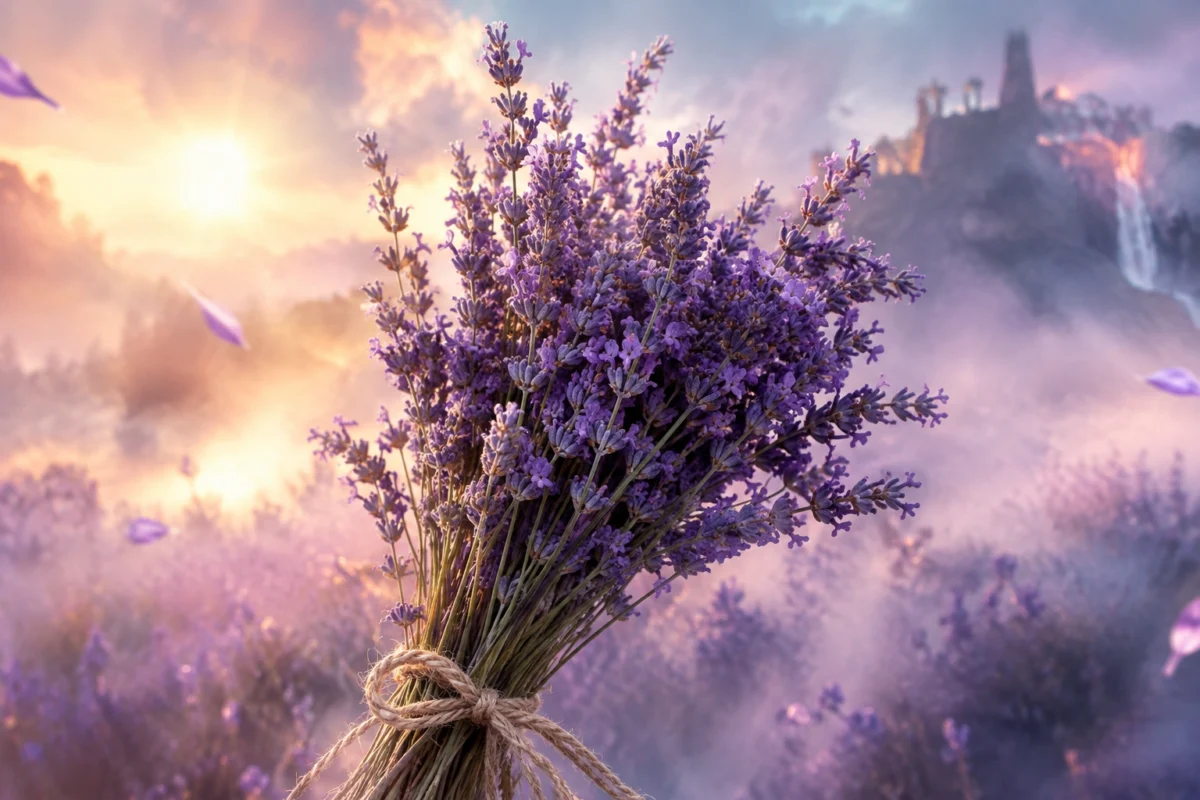
Dreaming about lavender may bring attention to calm, privacy, memory, care, or the atmosphere surrounding a situation. The plant’s color, scent, condition, and role in the dream can all shape what it means to you.
- Lavender Dream Examples
- Lavender Dream Meaning: Good or Bad?
- Different Cultures, Different Meanings
- Psychological Perspectives
- Lavender Symbol Variations & Context Cues
- Related Symbols & Common Combinations
- What You Should Do If You Dream About Lavender
- Lavender Vs Similar Dreams
- Sources & Further Reading
- FAQ
Lavender is a symbolic dream item, not a prediction or a fixed message. A healthy plant may feel reassuring, while wilted or overwhelming lavender may reflect discomfort, distance, or a detail you are unsure how to interpret.
Your personal associations matter most. Consider what lavender means to you when you are awake, what happened in the dream, and how you felt before deciding which interpretation fits.
Lavender Dream Examples
- You walk through a bright field of healthy lavender and feel at ease. The scene may connect with a wish for quiet, a pleasant pause, or a sense that your surroundings feel supportive.
- You find a pot of lavender with dry, brittle stems and feel disappointed. This could reflect concern that a source of comfort or a responsibility needs attention, though the image alone cannot establish why.
- You smell lavender somewhere but cannot see it. The unclear source may mirror an emotion, memory, or influence that is present without being easy to identify.
- A friend gives you a small lavender plant, and you accept it warmly. The exchange may relate to how you receive care, share a peaceful moment, or understand the tone of that particular relationship.
- You see lavender growing beside a busy road or in a crowded room. The contrast between the plant and the setting may highlight a need for personal space within a demanding environment.
- You cut lavender, bundle the stems, or place them in a jar. Your actions may point to organizing, preserving, or making practical use of something you value.
Lavender Dream Meaning: Good or Bad?
Condition gives you one useful clue. Fresh, thriving lavender can feel encouraging, while damaged plants or an unpleasant scent may match frustration or unease. These impressions are not verdicts: a wilted plant might simply reflect something you saw recently.
Agency matters too. Choosing to plant, gather, or give lavender can suggest active involvement, while watching it from a distance may fit a more observant or uncertain position. Notice whether your actions felt easy, forced, or unfinished.
Relationships and social settings can change the emphasis. Lavender offered by someone may bring the interaction into focus, while a plant in a public or crowded place may relate to the atmosphere around you. Overall, lavender is neither inherently good nor bad; its meaning depends on the dream’s details and your response.
Positive Interpretation
In the first example, a healthy field and a relaxed feeling appear together. That combination may suggest that your mind is giving space to rest, a welcome change of pace, or an environment you experience as reassuring. The feeling in the dream supports this reading more than the flower alone.
In the fourth example, you receive a plant from a friend and respond warmly. Because the exchange feels welcome, lavender may serve as an image for kindness or a comfortable connection. It does not prove what the other person thinks; the dream can reflect your own experience of the interaction.
In the sixth example, you gather and arrange the stems. Taking a clear action may connect the symbol with care, attention, or preserving something meaningful. If the task feels satisfying, the dream may reflect confidence in your ability to make a small, useful change.
A separate positive reading can fit a visible, well-kept lavender plant in an ordinary place, such as a windowsill. If you notice it without feeling rushed, the scene may express appreciation for a simple source of ease. The setting and your mood help distinguish this from a more uneasy image.
Negative Interpretation
In the second example, brittle stems and disappointment make neglect or fading comfort possible themes. The dream could echo a concern that something needs attention, but it is not evidence that a real relationship, plan, or personal quality is failing. Look for waking-life context before making that connection.
In the third example, a scent without a visible plant may feel unsettling because its source is unclear. It could reflect uncertainty or an emotion you have not named, but scent can also enter a dream through an ordinary memory or recent sensory experience. If you felt neutral, a troubling interpretation may not fit.
In the fifth example, lavender sits beside a busy road or inside a crowded room. If you feel overwhelmed, the contrast may mirror a wish for more quiet or separation from demands. If the scene feels pleasant instead, the plant may simply stand out as a calm detail within a lively setting.
A negative reading is also possible when someone gives you lavender and you refuse it, or when you feel pressured to care for a plant you do not want. The interaction could suggest reluctance or a boundary in that specific situation. Without clear discomfort or related waking context, however, the image offers weak evidence for conflict.
Different Cultures, Different Meanings
There is no single, stable cultural interpretation that can be applied to every lavender dream. Rather than assigning the flower a universal message, treat this as a set of modern symbolic and personal-context notes.
Personal associations: Your experiences with lavender, including a garden, a gift, a familiar scent, or a product you use, may matter more than a general symbol list. A positive or negative memory can change the dream’s tone.
Everyday sensory context: Lavender’s recognizable color and scent may appear in dreams because you recently encountered them or remembered them. In that case, the dream may combine ordinary memory with other concerns instead of carrying a special cultural meaning.
Different uses and settings: If you know lavender through gardening, decoration, or a specific personal practice, that context can shape the image. Avoid assuming that another person or tradition assigns the same meaning unless you have a reliable reason to make that connection.
Psychological Perspectives
From a symbolic or psychodynamic perspective, lavender might represent qualities you associate with it, such as calm, order, privacy, or care. A Jungian-style reading could explore the personal associations and contrasts in the dream, but it should remain a prompt for reflection rather than a universal code. Freud’s work is not needed to assign a fixed meaning to this particular plant.
From a cognitive and emotional-processing perspective, the dream may combine recent sights, smells, memories, and feelings. The plant’s condition or location can give the scene emotional shape, while the dream draws on familiar details without necessarily hiding a single message. Your own associations are useful evidence, but they do not make one interpretation certain.
Continuity-hypothesis approaches consider how dreams may reflect concerns and experiences from waking life. A busy setting, an unwanted task, or a calm garden could echo current themes if they resemble your recent experience. Threat-simulation ideas are less useful when a lavender dream contains no threat; do not force danger into a peaceful or neutral scene.
Lavender Symbol Variations & Context Cues
- Condition: Fresh, flowering lavender may feel different from wilted, moldy, or broken stems. Note what you thought the plant needed, if anything.
- Color or material: Purple flowers, green leaves, dried bundles, oil, or a lavender-colored object are not identical cues. Ask whether the dream focused on the plant itself, its scent, or its appearance.
- Number or scale: One small pot can suggest a contained, personal scene, while a huge field may make the symbol feel expansive. Quantity is a detail, not a fixed measure of importance.
- Movement or behavior: Planting, cutting, carrying, smelling, watering, or watching lavender gives you different roles. Consider whether your action felt voluntary and what happened afterward.
- Hidden, found, or lost: Finding an unexpected sprig may differ from searching for lavender or losing a bundle. These events can focus attention on discovery, uncertainty, or separation, depending on your response.
- Location or social setting: A bedroom, garden, shop, workplace, or crowded public place changes the scene. Notice who is present and whether the setting feels private, familiar, or demanding.
Related Symbols & Common Combinations
- Rose: Compare lavender with a rose dream to explore how a different flower, its condition, and your associations shape the emotional tone.
- Garden: A garden can add context about cultivation, growth, boundaries, or the setting in which lavender appears.
- Perfume: A perfume dream brings scent and its source to the foreground, which may help interpret lavender that is smelled but not seen.
- Herbs: An herb dream may connect lavender with practical uses, preparation, or the way you handle and arrange plants.
What You Should Do If You Dream About Lavender
Start with the plant’s condition. Write down whether it looked healthy, dry, damaged, or artificial, and note your first reaction. That detail may help you distinguish a reassuring scene from one that felt neglected or uncomfortable.
Record the color and material you noticed. Purple flowers, green stems, dried lavender, or a scented product may call up different memories for you. Avoid treating a color as a universal symbol; focus on what you associate with that exact form.
Think about number and scale. One sprig, a small pot, and a broad field create different settings and levels of emphasis. Ask whether the amount felt ordinary, striking, excessive, or difficult to manage, rather than assuming that more lavender means more of one thing.
Review your interaction with it. You might have planted, received, cut, smelled, carried, avoided, or simply watched the lavender. Consider what you intended and whether the action brought relief, pressure, curiosity, or no strong feeling.
Finally, note where the scene happened and who was there. A quiet garden may bring a different association than a crowded room or workplace. If a connection to waking life comes to mind, treat it as one possible interpretation to consider, not as proof or a prediction.
Lavender Vs Similar Dreams
| Aspect | Lavender | Rose | Jasmine | Rosemary |
|---|---|---|---|---|
| Occasion/Age or Context | Personal associations with the plant, its color, or its scent | Depends on the flower’s appearance and your associations | Depends on its scent, setting, and personal familiarity | Depends on how the herb appears or is used |
| Core Theme | Possible calm, privacy, care, or contrast with a busy setting | Possible attention to beauty, feeling, or a particular association | Possible focus on scent, memory, or atmosphere | Possible focus on an herb, its practical use, or handling |
| Typical Emotions | Peace, uncertainty, comfort, or discomfort | Affection, appreciation, unease, or neutrality | Curiosity, calm, memory, or uncertainty | Practical focus, curiosity, or indifference |
| Common Symbols | Flowering stems, dried bundles, pots, scent, gardens | Bloom, thorn, bouquet, gift, garden | Flower, scent, night setting, plant | Leaves, sprigs, cooking, garden |
More in this category: Nature dreams.
Sources & Further Reading
- NINDS Brain Basics: Understanding Sleep Sleep science
- APA Dictionary of Psychology: Dream Analysis Psychology reference
- Dreaming and the Brain: From Phenomenology to Neurophysiology Research
- Sleep and Dreaming Are for Important Matters Research
- Sleep Foundation: Dreams Editorial background
- Sleep Health Foundation: Dreaming Sleep science