

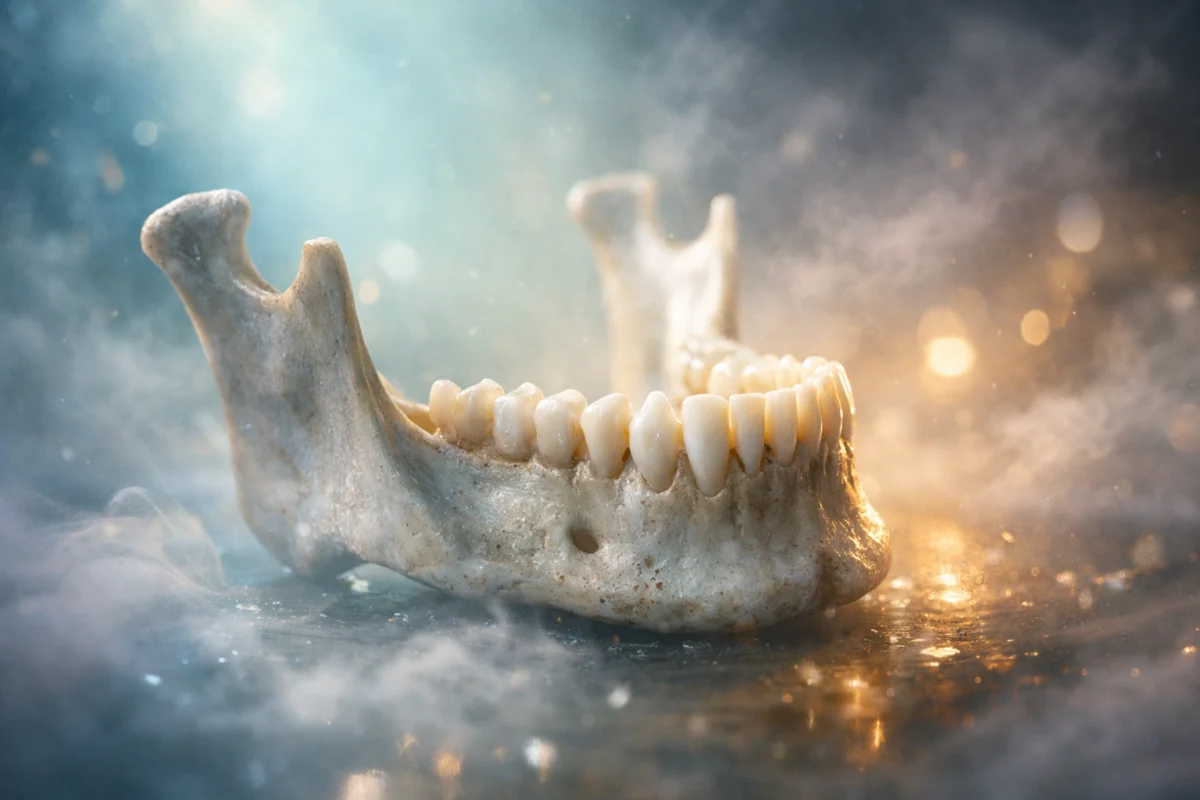
A jaw in a dream often points to how you hold, control, release, or protect expression. It can connect with speaking, silence, pressure, determination, anger, hunger, or the way you “bite into” a problem.
This symbol is not a prediction and it is not a diagnosis. A dream about a jaw does not automatically mean something is wrong with your body or your relationships. It works better as a reusable symbol for tension, communication, restraint, and personal force.
The meaning depends on the jaw’s condition, movement, setting, and your role in the dream. A strong jaw, a locked jaw, a broken jaw, or an animal jaw will not carry the same emotional message.
Jaw Dream Examples
- You look in a mirror and see your jaw looking strong, balanced, and calm while you prepare to speak at an important meeting.
- Your jaw locks shut during an argument, and you feel panic because you cannot say what you need to say.
- You find a strange golden jawbone on a beach and feel unsure whether it is beautiful, valuable, or unsettling.
- Someone you love touches your jaw gently and asks if you are holding back your real feelings.
- You stand in a dentist’s office while a giant model jaw opens and closes on the counter beside you.
- You bite down hard on a rope to pull yourself out of deep water, using your jaw to survive and move forward.
Jaw Dream Meaning: Good or Bad?
A jaw dream can feel good when the jaw is strong, flexible, pain-free, or helping you act with purpose. This may show that you are ready to speak clearly, stand firm, or handle pressure without losing control.
It can feel negative when the jaw is locked, broken, painful, exaggerated, or out of your control. In that case, the dream may reflect blocked expression, stress, emotional clenching, or a situation where you feel forced to stay quiet.
Social context matters. If another person is touching, threatening, admiring, or injuring the jaw, the dream may be about how communication works between you and others. Overall, a jaw dream is not automatically good or bad; it depends on whether the jaw shows control, pressure, injury, or useful action.
Positive Interpretation
If you see a strong, balanced jaw in a mirror before speaking, the dream may point to growing confidence. The cause is your awareness of self-presentation, and the effect is a sense that your words can carry weight without needing force. This dream can appear when you are preparing to be more direct.
If your jaw helps you bite a rope and pull yourself from water, the symbol becomes active and practical. The cause is pressure or emotional depth, shown by the water. The effect is survival through focus, grip, and determination. Your dream may be showing that you have more inner traction than you realize.
If a loved one gently touches your jaw and asks about your feelings, the dream may show a safe opening for honesty. The cause is relational closeness, and the effect is a chance to soften defensive control. This does not force a romance meaning; it can apply to any trusted bond where truth feels possible.
If you find a golden jawbone and feel curious rather than afraid, the jaw may represent valuable insight about expression, boundaries, or personal strength. The cause is discovery, and the effect is reflection. Gold can suggest worth, but the dream still asks what this “valuable voice” means in your current life.
Negative Interpretation
If your jaw locks during an argument, the dream may reflect the pain of not being able to answer back. The cause is conflict, and the effect is blocked speech or helplessness. This is most meaningful if you woke with strong frustration or if the dream focused on being unheard.
If the jaw is broken, bleeding, or falling apart, it can suggest that your usual way of speaking, defending yourself, or staying composed feels damaged. The dream evidence is stronger if the broken jaw appears after a fight, insult, or public pressure. If the injury appears randomly, the meaning may be more general stress than a specific relationship issue.
If the giant model jaw in the dentist’s office feels threatening, the dream may magnify concern about examination, correction, or being judged. The cause is the clinical setting, and the effect is feeling watched or evaluated. This does not mean a medical issue is coming; it may simply use a familiar setting to symbolize vulnerability.
If an animal jaw, sharp teeth, or snapping movement appears, the dream may point to aggression, fear of being attacked, or your own urge to respond sharply. The meaning is limited if the animal is not central to the dream. A passing image may be less important than the emotion, location, and interaction around it.
Different Cultures, Different Meanings
Modern symbolic context: The jaw does not have one stable meaning across all cultures. In most dream interpretation, it is safer to read it through speech, tension, power, appetite, and restraint rather than claim a single traditional message.
Language and everyday metaphor: Many people connect the jaw with phrases like “set your jaw,” “jaw-dropping,” or “clenched jaw.” These are not ancient rules, but they can shape your personal dream language. If such phrases feel familiar to you, they may help decode the dream.
Body-based symbolism: In many modern wellness and psychological contexts, the jaw is associated with holding tension. In dreams, this can become a symbol of emotional control or unspoken pressure. This is symbolic, not a medical conclusion.
Personal and family context: If you grew up hearing comments about strong jaws, dental work, speech, appearance, or self-control, those memories may matter more than any public symbolism. Your lived associations are often the best guide.
Psychological Perspectives
From a symbolic or psychodynamic view, a jaw may represent the border between inner feeling and outer speech. Freud and Jung are often linked with symbolic dream analysis, but you do not need to force one fixed theory here. A jaw can show what you are holding in, what you want to bite back, or how you present strength.
From a cognitive and emotional-processing view, the dream may organize recent stress around communication, decision-making, conflict, or self-control. If you spent the day speaking carefully, swallowing irritation, preparing a presentation, visiting a dentist, or worrying about appearance, the mind may reuse the jaw as a simple image for that load.
From the continuity hypothesis, dreams often continue waking concerns in altered form. From threat-simulation theory, associated with Antti Revonsuo, dreams may rehearse danger or defense. A snapping jaw, locked mouth, or painful bite can therefore model social threat, conflict, or pressure without predicting that it will happen.
Jaw Symbol Variations & Context Cues
- Condition: A healthy jaw may suggest confidence or readiness, while a locked, swollen, broken, or painful jaw may point to stress, blocked expression, or reduced control.
- Color or material: A golden, silver, stone, glass, wooden, or metal jaw changes the tone. Gold may suggest value, glass may suggest fragility, stone may suggest stubbornness, and metal may suggest hardness or defense.
- Number or scale: One jaw keeps the meaning personal, while many jaws may suggest social pressure, many opinions, or repeated demands. A giant jaw can magnify fear, authority, appetite, or judgment.
- Movement or behavior: Clenching, chewing, biting, talking, grinding, opening, or snapping each adds action. Ask whether the jaw is helping you communicate, protecting you, or trapping you.
- Hidden, found, or lost: A hidden jaw may show avoided expression. A found jawbone may suggest recovered strength or old words returning. A missing jaw may symbolize feeling unable to respond.
- Location or social setting: A jaw in a mirror may involve self-image. A jaw at work may involve performance. A jaw at a family table may involve conversation patterns. A jaw in a clinic may involve evaluation or vulnerability.
Related Symbols & Common Combinations
- Teeth: Teeth with a jaw can sharpen the meaning toward confidence, pressure, appearance, biting words, or fear of losing control.
- Mouth: A mouth dream expands the theme into speech, hunger, secrets, silence, or what you allow in and out of your life.
- Throat: A throat symbol often points to voice, truth, restriction, or the effort to say something that feels difficult.
- Biting: Biting adds action, showing defense, desire, anger, survival, or the need to take hold of a situation.
What You Should Do If You Dream About Jaw
Start with the jaw’s condition. Was it healthy, tight, locked, broken, animal-like, artificial, or missing? A calm jaw may point to readiness, while a damaged or frozen jaw may suggest that some part of your expression feels strained. Do not jump to a body fear; read the dream as symbolic first.
Notice color and material. A metal jaw may show toughness or guarded speech. A glass jaw may show sensitivity or fear of being hurt by words. A golden jaw may highlight the value of what you want to say. The material often shows the emotional texture of the symbol.
Look at number and scale. A single jaw may reflect your own voice or control. Many jaws may suggest too many opinions around you. A huge jaw may show that a conversation, criticism, appetite, or demand feels larger than life. If the dream made it cartoonishly big, your mind may be using visual volume because subtlety was on vacation.
Pay attention to interaction. Were you speaking, biting, clenching, being examined, being touched, or being attacked? Your role matters. If you used the jaw to act, the dream may show agency. If the jaw trapped you, the focus may be restraint or pressure.
Finally, connect the setting to waking life. A workplace jaw dream may relate to performance or authority. A dinner-table jaw may involve conversation and appetite. A clinic may suggest scrutiny or correction. A beach jawbone may bring up discovery, memory, or something old becoming meaningful again.
Jaw Vs Similar Dreams
| Aspect | Jaw | Teeth | Mouth | Throat |
|---|---|---|---|---|
| Occasion/Age or Context | Often appears during pressure, conflict, self-control, or moments when you need to hold firm. | Often appears around confidence, appearance, change, vulnerability, or fear of loss. | Often appears when speech, hunger, secrets, or emotional intake and output are central. | Often appears when you feel blocked, unheard, exposed, or close to saying something important. |
| Core Theme | Control, tension, determination, restraint, and the force behind expression. | Stability, self-image, personal power, anxiety, and the ability to bite or process experience. | Communication, desire, silence, nourishment, and what crosses the boundary between inside and outside. | Voice, vulnerability, truth, restriction, and the passage between feeling and speech. |
| Typical Emotions | Pressure, resolve, frustration, stubbornness, fear, or focused strength. | Anxiety, embarrassment, concern, relief, pride, or insecurity. | Curiosity, shame, hunger, urgency, openness, or fear of saying too much. | Tightness, fear, courage, sadness, relief, or the need to be heard. |
| Common Symbols | Locked jaw, jawbone, bite, clench, animal jaw, mirror, dentist office. | Loose teeth, falling teeth, broken teeth, white teeth, braces, chewing. | Open mouth, closed mouth, lips, tongue, shouting, whispering, eating. | Choking, sore throat, singing, necklace, scarf, swallowing, blocked voice. |
See Also
More in this category: Body parts dreams.
Sources & Further Reading
- NINDS Brain Basics: Understanding Sleep Sleep science
- APA Dictionary of Psychology: Dream Analysis Psychology reference
- Dreaming and the Brain: From Phenomenology to Neurophysiology Research
- Sleep and Dreaming Are for Important Matters Research
- Sleep Foundation: Dreams Editorial background
- Sleep Health Foundation: Dreaming Sleep science