

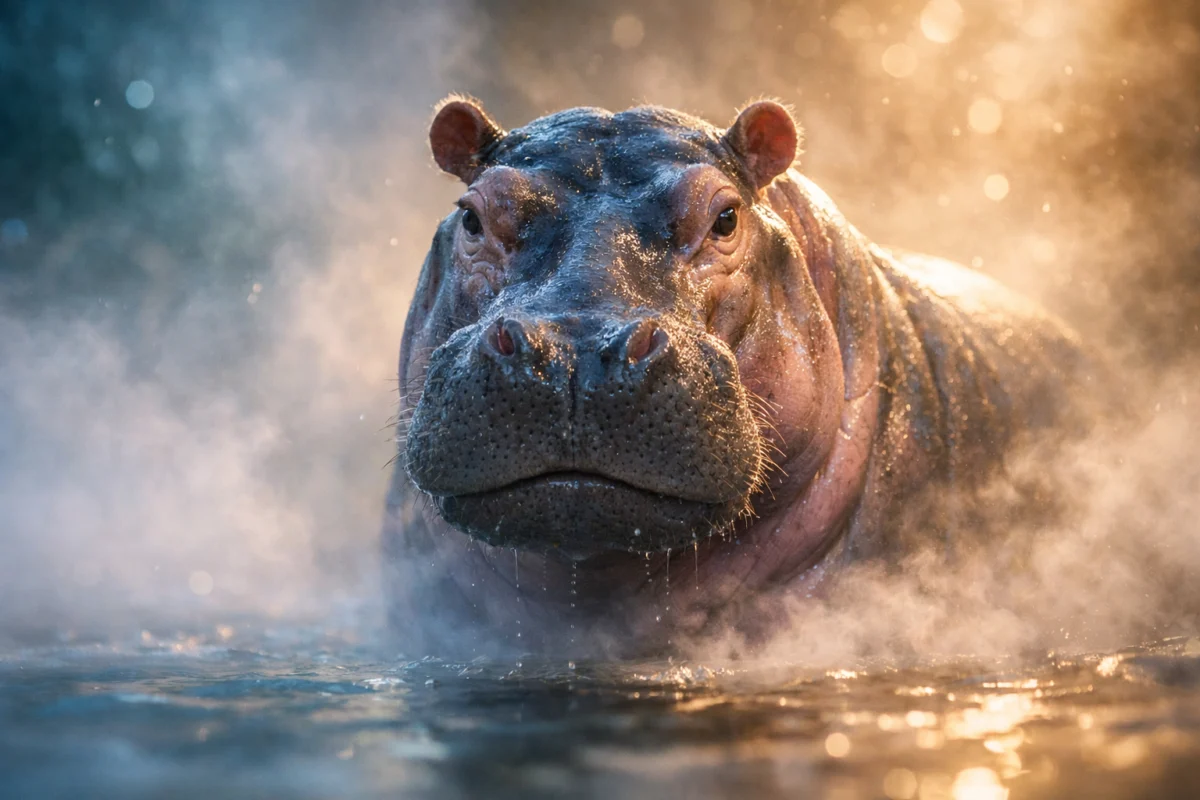
A hippopotamus in a dream often points to powerful feelings, strong boundaries, hidden pressure, or a situation that looks calm on the surface but carries real force underneath. Because a hippo lives in water and on land, it can connect emotional depth with practical life.
- Hippopotamus Dream Examples
- Hippopotamus Dream Meaning: Good or Bad?
- Different Cultures, Different Meanings
- Psychological Perspectives
- Hippopotamus Symbol Variations & Context Cues
- Related Symbols & Common Combinations
- What You Should Do If You Dream About Hippopotamus
- Hippopotamus Vs Similar Dreams
- See Also
- Sources & Further Reading
- FAQ
This symbol is not a prophecy. It does not mean something bad will happen, and it does not define your personality. It works best as a reusable dream image that asks you to notice size, behavior, location, and your own reaction.
In many dreams, the hippopotamus shows where you feel protective, crowded, underestimated, or quietly strong. The meaning changes depending on whether the hippo is peaceful, aggressive, hidden in water, with a group, or interacting directly with you.
Hippopotamus Dream Examples
- You see a calm hippopotamus floating in clear water while you watch from a safe riverbank.
- A large hippopotamus charges at you through muddy water, and you try to escape.
- You find a baby hippopotamus in your backyard and feel unsure whether to help it or leave it alone.
- A hippopotamus stands between you and someone you know, blocking the path but not attacking.
- You are in a zoo or wildlife park, and a hippopotamus watches you from behind a barrier.
- You feed a hippopotamus, ride beside it in a boat, or guide it away from a crowded place.
Hippopotamus Dream Meaning: Good or Bad?
A hippopotamus dream can feel good when the animal is calm, healthy, distant enough to feel safe, or moving naturally in water. In that case, it may show emotional strength, steady boundaries, or a growing ability to stay composed around strong feelings.
It can feel negative when the hippo is charging, trapped, injured, too close, or blocking your way. These details may point to pressure, defensiveness, fear of confrontation, or a situation where something feels much bigger than you expected.
Social context also matters. A hippo near other people may reflect boundaries in a group, tension in a relationship, or the need to respect someone’s space, including your own. Overall, a hippopotamus dream is not simply good or bad; it is a power symbol whose meaning depends on condition, agency, and context.
Positive Interpretation
If you see a calm hippopotamus floating in clear water, the dream may show that you are learning to hold strong emotions without being overwhelmed by them. The clear water suggests that you can see what you feel, and the safe distance suggests that you are not being swallowed by the emotion.
If you find a baby hippopotamus and feel protective, the dream may point to a new but powerful part of your life that needs careful handling. Because a baby hippo is small but still linked to a strong adult animal, it can symbolize early confidence, a new boundary, or a responsibility that will grow.
If the hippopotamus stands between you and another person without attacking, it may show that a boundary is actually protecting you. The dream may be asking you to pause before rushing into a conversation, commitment, or conflict. The obstacle can be useful if it gives you time to think.
If you guide a hippopotamus away from a crowded place, the dream may reflect your ability to manage intense energy in a practical way. You are not fighting the animal, ignoring it, or pretending it is tiny. You are directing force with care, which suggests calm leadership and emotional skill. Not bad for an animal built like a floating couch.
Negative Interpretation
If a hippopotamus charges at you through muddy water, the dream may point to a feeling that has become urgent, unclear, or hard to avoid. Muddy water can suggest confusion, while the charge shows pressure. The dream does not prove danger in real life, but it may reflect stress that feels forceful.
If the hippo blocks your path and you feel trapped, the symbol may show a difficult boundary or power dynamic. This could involve a person, a rule, a responsibility, or your own reluctance. If the dream gives little detail, avoid assuming the blockage is caused by one specific person.
If the hippopotamus is injured, caged, or unable to move, it may suggest that strength is being limited or expressed poorly. You may be holding back anger, avoiding a needed boundary, or feeling that your natural force has no safe place to go. The dream points to containment, not necessarily failure.
If you are feeding a hippo and feel afraid, the dream may show that you are giving too much attention, energy, or permission to something that already feels oversized. This interpretation is stronger if the animal becomes demanding. If it remains calm, the meaning may be more about care, responsibility, and learning limits.
Different Cultures, Different Meanings
Modern symbolic context: In many contemporary dream dictionaries, a hippopotamus is read through its visible traits: size, water, territory, and hidden strength. This is a practical symbolic approach rather than a fixed tradition.
Wildlife and nature context: Because real hippos are large, aquatic mammals known for strong territorial behavior, dreamers often associate them with boundaries, force, and the difference between a calm appearance and intense power. Personal experience with animals matters more than a general rule.
Ancient Egypt note: Hippopotamuses did appear in ancient Egyptian religious and artistic contexts, including both protective and dangerous associations. For dream interpretation today, use this cautiously unless Egyptian imagery, gods, temples, or symbols appeared directly in the dream.
Personal memory context: If you saw hippos in a documentary, zoo, book, game, or childhood memory, the dream may borrow from that source. In that case, your own association may be stronger than any broad cultural meaning.
Psychological Perspectives
From a symbolic or psychodynamic view, a hippopotamus may represent instinctive emotional power that is partly submerged. A Jungian reading might see it as a large instinctual image from the unconscious, especially because it moves between water and land. A Freudian reading would be more cautious and would look at personal associations rather than assigning one fixed meaning.
From a cognitive or emotional-processing view, the dream may be your mind sorting recent stress, strong reactions, or boundary issues into a memorable animal image. The hippo’s size helps the brain give shape to something that feels large, hard to ignore, or difficult to move around.
From continuity-hypothesis or threat-simulation perspectives, the dream may continue waking concerns in symbolic form. If you have been dealing with pressure, a difficult person, crowded spaces, or a need to protect yourself, the hippo may appear as a realistic-feeling challenge that lets your mind rehearse caution, distance, and response.
Hippopotamus Symbol Variations & Context Cues
- Condition: A healthy hippo may suggest stable strength, while an injured, sick, or trapped hippo may point to blocked power, stress, or a boundary that needs attention.
- Color or material: A natural gray or brown hippo often feels grounded and realistic. A white, black, golden, toy, stone, or cartoon hippo may shift the meaning toward purity, shadow, value, play, rigidity, or exaggeration.
- Number and scale: One hippo can show one major issue or force. Many hippos may suggest group pressure, social boundaries, family or workplace dynamics, or emotions that feel multiplied.
- Movement and behavior: Floating, sleeping, watching, charging, chasing, eating, or protecting young all change the message. Notice whether the animal is peaceful, defensive, curious, or aggressive.
- Hidden, found, or lost: A hippo hidden under water may point to an emotion you sense but cannot fully see. A found hippo may show a new awareness. A lost hippo may suggest uncertainty about where your strength belongs.
- Location and social setting: A river, swamp, zoo, house, street, school, workplace, or crowded public area reveals where the theme may be active. The people nearby can show whether the dream is personal, social, or situational.
Related Symbols & Common Combinations
- River: A river with a hippopotamus often highlights emotional movement, life direction, and how safely you are navigating strong feelings.
- Elephant: An elephant beside or instead of a hippo may shift the theme toward memory, wisdom, family groups, or patient strength.
- Crocodile: A crocodile near a hippopotamus can add hidden danger, survival instinct, or tension between visible force and concealed threat.
- Zoo: A zoo setting may show controlled power, observation, social rules, or the feeling that instinctive parts of life are being contained.
What You Should Do If You Dream About Hippopotamus
Start with the hippo’s condition. Ask whether it was healthy, injured, trapped, calm, or distressed. A strong and peaceful animal may point to inner stability, while a wounded or confined one may suggest that a strong feeling or boundary has not found a healthy form.
Next, note color and material. A realistic hippo may connect to practical concerns, while an unusual color or toy-like hippo may show that the dream is exaggerating, softening, or symbolizing the theme in a less literal way. Do not force a meaning from color alone; use it with the full scene.
Then consider number and scale. One giant hippo may reflect one large pressure. A group may point to many voices, many responsibilities, or a social environment that feels heavy. A baby hippo may show something new that is small now but carries future weight.
Look at your interaction. Were you running, feeding, watching, guiding, hiding, or touching the hippo? Your role shows how you relate to power in the dream. Avoiding the animal may suggest fear or caution, while guiding it may suggest growing skill with intense emotions or difficult situations.
Finally, connect the location and social context to waking life. A hippo in your home may point to private boundaries. A hippo at work or school may reflect public pressure or group rules. A hippo in water may focus more on emotion, while one on dry land may show that a hidden feeling is becoming visible.
Hippopotamus Vs Similar Dreams
| Aspect | Hippopotamus | Elephant | Crocodile | Rhinoceros |
|---|---|---|---|---|
| Occasion/Age or Context | Often appears in dreams about boundaries, emotional weight, or calm power that may suddenly feel intense. | Often appears in dreams about memory, loyalty, patience, family groups, or long-term responsibility. | Often appears in dreams about hidden fear, instinct, danger, or something waiting below the surface. | Often appears in dreams about direct force, defense, stubbornness, or pushing through obstacles. |
| Core Theme | Submerged strength, territory, emotional pressure, and the need to respect limits. | Wisdom, endurance, memory, protection, and the weight of experience. | Concealed threat, survival instinct, suspicion, and alertness. | Armor, impact, determination, and blunt resistance. |
| Typical Emotions | Awe, caution, tension, curiosity, protection, or fear of being overwhelmed. | Respect, comfort, sadness, patience, duty, or grounded strength. | Anxiety, suspicion, urgency, dread, or sharp alertness. | Pressure, determination, frustration, fear, or a need to stand firm. |
| Common Symbols | Water, mud, riverbanks, zoo barriers, babies, groups, blocked paths, or feeding. | Herds, tusks, memory objects, forests, temples, roads, or family scenes. | Swamps, teeth, dark water, ambush, reptiles, banks, or narrow escapes. | Horns, dust, open land, armor-like skin, charging, gates, or obstacles. |
More in this category: Animals dreams.
Sources & Further Reading
- NINDS Brain Basics: Understanding Sleep Sleep science
- APA Dictionary of Psychology: Dream Analysis Psychology reference
- Dreaming and the Brain: From Phenomenology to Neurophysiology Research
- Sleep and Dreaming Are for Important Matters Research
- Sleep Foundation: Dreams Editorial background
- Sleep Health Foundation: Dreaming Sleep science